




Roaccutane (Isotretinoin) Before and After Rhinoplasty
Dr. Hamidreza Hosnani
ENT Specialist | Rhinoplasty Surgeon in Tehran | Nose Surgery Specialist
Isotretinoin (known by brand names such as Roaccutane, Accutane, or Dacutan) is a derivative of vitamin A used to treat acne. These medications should be stopped one month before surgery because they may increase the risk of skin damage during the procedure. They should also not be used for at least one month after rhinoplasty.
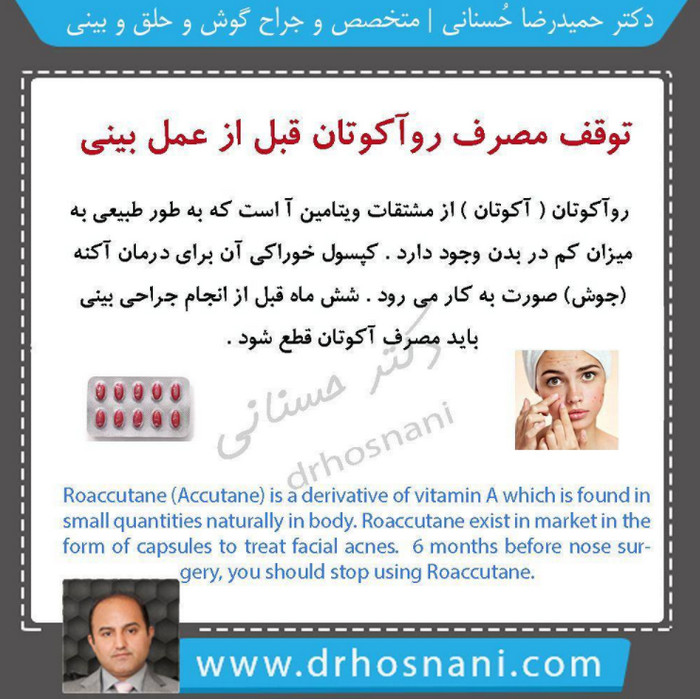
Regarding Roaccutane, it is currently recommended to stop taking it one month before rhinoplasty and avoid it for one month after surgery.
Isotretinoin (Roaccutane) and Cosmetic Rhinoplasty
In past years, the use of isotretinoin, commonly known by brand names such as Roaccutane and Accutane, was considered a risk factor for cosmetic procedures, especially rhinoplasty. However, with the progress of medical research, this perspective has changed, and today many specialists believe that controlled and informed use of this medication is not necessarily a barrier to nasal surgery.In this article, we examine the scientific basis of this topic, the advantages and disadvantages of isotretinoin use around the time of nose surgery, and the cautious view of Dr. Hamid Reza Hosnani.
The Traditional Belief About Roaccutane and Nose Surgery
In the past, it was believed that isotretinoin:• slows wound healing
• increases the risk of hypertrophic scars or keloids
• makes the skin excessively thin and fragile
These beliefs were formed mostly on the basis of older reports and limited experience rather than large-scale, controlled studies.
What Do the New Scientific Findings Say?
Research conducted over the past 15 to 20 years has shown that:• in many patients, isotretinoin does not cause serious impairment in wound healing
• the rate of infection and abnormal scarring does not increase significantly in users
• collagen production remains normal in most individuals
For this reason, many dermatologists and plastic surgeons no longer regard this medication as an absolute contraindication.
The Role of Isotretinoin in Thick-Skinned Noses
Individuals with thick and oily nasal skin often face the following issues:• a broad and bulky nasal tip
• prolonged swelling after surgery
• delayed visibility of nasal refinement
By reducing sebaceous gland size and decreasing skin thickness, isotretinoin may:
• help make the nasal skin thinner
• make the final nasal shape appear more clearly
• reduce the duration of swelling after surgery
For this reason, some physicians use this medication as an adjunct in selected cases.
Dr. Hamid Reza Hosnani’s View on Roaccutane Use
Dr. Hamid Reza Hosnani, as one of the experienced nasal cosmetic surgeons, adopts a cautious approach and believes:
“Although recent studies have shown that isotretinoin does not necessarily prevent wound healing, for greater patient safety it is better to stop Roaccutane one month before rhinoplasty and resume it at least one month after cosmetic nose surgery.”

Dr. Hosnani’s Video Explanation About Roaccutane
This cautious approach helps:• minimize potential risks
• give the skin enough time for initial recovery
• allow the healing process to proceed more comfortably
Final Summary
Isotretinoin is no longer considered an absolute contraindication for rhinoplasty as it once was.In some patients with thick skin, it may even help improve the result.
However, observing an appropriate interval before and after surgery remains the safest approach.
The best decision should always be made by the surgeon based on the patient’s individual condition. If you are planning rhinoplasty and have a history of Roaccutane use, be sure to discuss it with your surgeon so that an appropriate treatment plan can be arranged for you.
Isotretinoin:
• reduces the size of sebaceous glands• decreases sebum secretion
• reduces skin thickness
• has anti-inflammatory effects
As a Result:
• the skin becomes thinner and more flexible• the shape of the nasal tip becomes more visible after surgery
• prolonged swelling is reduced
• the chance of sebaceous gland enlargement after surgery decreases
• therefore, in some patients, this medication improves the quality of the surgical result.
The Importance of a Low Dose
When isotretinoin is used alongside rhinoplasty, it is usually:prescribed in low doses (for example, 10 to 20 mg per day)
under close medical supervision
sometimes only for a limited period before or after surgery
in order to preserve the benefits while reducing the side effects of severe dryness.
Why Do Some Surgeons Still Exercise Caution?
Despite the new evidence:
some physicians remain cautious because of older practice patterns
high doses may make the skin excessively sensitive
individuals with a history of keloids or impaired healing require a more detailed evaluation
for this reason, practices vary among physicians.
Current Perspective in Summary
Most specialists today believe:✔ isotretinoin is not an absolute contraindication for rhinoplasty
✔ it may be helpful in patients with thick skin
✔ the final decision should be based on the individual patient’s condition
Final Conclusion
This shift in perspective has occurred because modern science has replaced older assumptions. Isotretinoin is now regarded not only as a medication that does not necessarily pose a definite risk to wound healing, but also, in suitable patients, as a tool that may improve skin quality and the outcome of nose surgery.References:
1. Use of Isotretinoin in Rhinoplasty: A Literature ReviewA comprehensive review of the role of isotretinoin in rhinoplasty and whether it truly increases the risk of poor wound healing and scarring — the findings indicate that there is no strong evidence of increased risk.
2. Analysis of the Effects of Isotretinoin on Rhinoplasty Patients
A study of 350 rhinoplasty patients who received isotretinoin showed that the medication did not impair wound healing and even increased patient satisfaction.
3. Oral isotretinoin (Roaccutane) use during incisional surgery: safe or risky?
A report of two cases of healthy skin tissue after surgery in patients taking Roaccutane, along with a review of scientific articles showing no relationship with impaired healing or increased scarring.
4. Isotretinoin and Timing of Procedural Interventions: Systematic Review With Consensus Recommendations (JAMA Dermatology)
A systematic review of the evidence on whether isotretinoin must be discontinued before dermatologic surgery — the conclusion was that delaying surgery is not based on strong evidence and should be weighed alongside clinical experience.
5. A systematic review on oral isotretinoin therapy and clinically observable wound healing
A systematic review on the relationship between isotretinoin and wound healing, showing no clear link between medication use and poor healing, and suggesting that mandatory delays in elective procedures may not be necessary.
6. Optimizing Rhinoplasty Outcomes: The Role of Isotretinoin and Patient Management Strategies: Systematic Review
A review of multiple studies found that isotretinoin may improve aesthetic outcomes and proper healing in patients with thick nasal skin.
Learn More About Accutane or Isotretinoin
Isotretinoin was approved in 1982 by the U.S. Food and Drug Administration (FDA) for the treatment of nodular cystic acne. Today, this medication is used not only for cystic or nodular acne, but also for all types of acne. Severe acne, postmenopausal acne, and even rhinophyma can be treated with this drug. Isotretinoin is the only oral medication that acts on all of the major factors involved in acne formation. It reduces sebum production, decreases comedogenesis, and also lowers the number of Propionibacterium acnes bacteria responsible for acne. Isotretinoin also has anti-inflammatory effects. It is a derivative of vitamin A, metabolized in the liver, and eliminated through the body.It is better to take this medication with food. Tetracycline should not be used together with Roaccutane. Individuals taking this medication should avoid alcohol and should not take vitamin A concurrently. It interacts with carbamazepine, ketoconazole, and salicylic acid. Its teratogenic effects, meaning its harmful effects on the fetus, have been proven; in other words, it can cause fetal developmental disorders. Therefore, no attempt at pregnancy should be made from one month before taking it until one year after stopping it. People with diabetes and those with high blood lipids should be monitored more carefully while using this medication. Other patients should also undergo regular liver function tests.