




Advertising Deceptions Regarding Rhinoplasty
Dr. Hamidreza Hosnani
ENT Specialist | Rhinoplasty Surgeon in Tehran | Nose Surgery Specialist
Claims such as rhinoplasty without a splint, rhinoplasty without pain and bleeding, and similar statements are sometimes heard here and there. I have not heard of a colleague who would make such promises to a patient in exchange for more money.

Nose Gel (Filler) Injection
In recent years, non-surgical methods for improving the appearance of the nose have attracted attention. Among these methods are gel (filler) injections and fat injections. These techniques are performed without surgical incisions and are usually used to correct certain minor irregularities in the shape of the nose. However, it should be noted that these methods have significant limitations and cannot replace rhinoplasty (nose surgery). 
Injecting filler into the nose before surgery may temporarily change the shape of the nasal bridge or tip and can sometimes mask minor irregularities. However, the presence of filler during surgery can make it more difficult for the surgeon to accurately evaluate natural tissues, the true size of a hump, or existing depressions. Improperly injected fillers may also cause inflammation or fibrosis. For this reason it is usually recommended to wait several months for temporary fillers to dissolve, or to remove permanent fillers during surgery so that the nasal framework can be designed accurately. According to Dr. Hosnani, preoperative evaluation should ideally be performed without the influence of injectable materials to ensure a more predictable surgical outcome.
Limitations of Gel Injection:
Temporary results: The effect of gel injection is not permanent and usually lasts between 6 months and 2 years, depending on the type of gel and the individual's body metabolism.No size reduction: Gels can only highlight or fill certain areas and are not able to make the nose smaller or change its bone and cartilage structure.
Risk of complications: Although rare, injection in the nasal area carries a high risk. Incorrect injection into blood vessels can lead to vascular obstruction, necrosis (tissue death), or even blindness.
Limited changes: For complex corrections, breathing problems caused by a deviated nasal septum, or fundamental changes in the shape of the nose, gel injection is not sufficient.
Limitations of Fat Injection:
Unpredictable absorption: The rate of absorption of grafted fat is highly variable and may produce uneven or unpredictable results.Possibility of lumps: Sometimes the injected fat accumulates in small masses or lumps.
Two-step process: This method is more invasive than gel injection and requires harvesting fat from another area of the body.
Inability to reduce the nose: Like gel, fat also cannot make the nose smaller.
Why Doesn't Gel/Fat Injection Replace Nose Surgery?
Rhinoplasty (nose surgery) is a structural intervention that can:Make the nose smaller: by removing excess bone and cartilage.
Change the overall shape of the nose: including the nasal tip, bridge, nostril width, and deviations.
Resolve breathing problems: such as a deviated nasal septum (simultaneous septoplasty).
Provide permanent and predictable results: through precise design and surgical execution by a skilled surgeon.
In contrast, gel and fat injections merely work by adding volume and are unable to remove tissue, change cartilage or bone structure, or resolve breathing problems. They are more suitable for making small and subtle changes or covering minor imperfections.
Mold-Guided Surgery
One of the wishes of cosmetic surgery applicants is to be able to determine the outcome of their surgery. In response to this request, various methods have been proposed. One of these proposed methods is the mold (template). The idea is that the patient can determine the surgical result. A mold is taken from the desired result, and the surgeon attempts to create that result during the operation.This subject is very dreamy and interesting, but it is far from reality.
Why Don't I Perform Mold-Guided Surgery?
Firstly, the nose is different from toy wax and has living tissue. It is not the case that we can apply any change to it and have it be feasible. In order to avoid damaging the nose and preserving its health, there are many limitations in front of the surgeon; if these are violated, the nose may be harmed, and the applicant's breathing, sense of smell, and beauty may become impaired.Therefore, the claim that the nose can be created exactly according to the applicant's request is far from reality. At most, the surgeon can apply changes to the extent that the patient is not harmed.
In addition to the above, after surgery and during the healing process, many changes occur in the shape of the nose over a period of one or two years that are not predictable. In other words, the actual result of the surgery is achieved two years after the operation. Therefore, even if, hypothetically, it were possible to create the desired result during surgery, this result would differ greatly from the final result, and that mold taken during surgery would bear no relation to the result the applicant desires.
A skilled surgeon is someone who can make changes such that after two years, the result is what the patient wanted. In other words, the condition is that the surgical mold resembles the nose after two years have passed since the surgery.
Given the above explanations, using a mold during surgery is a matter that may help the surgeon in the future, but it does not help at present.
Doll-Like Nose Surgery
The doll-like nose has become known as a beauty trend in recent years. This type of nose, whose characteristics include a small size and an upturned tip, is often seen among photography faces and cartoon and doll characters. Although this nose shape may seem attractive and beautiful to some people, it has features that can be dysfunctional in practice. 
Requesting a “doll‑like” nose in rhinoplasty usually means a small nose with an upturned tip and a curved bridge. While some people consider this attractive, performing such surgery without considering facial proportions and breathing function may cause nasal obstruction, an unnatural appearance, or the need for revision surgery. Therefore, surgeons generally recommend maintaining natural proportions.
Lack of proportion with the face:
Because of its specific size and shape, a doll-like nose may not match the facial features of many individuals. Each person has unique physical characteristics that must be taken into account. The nose should be designed in such a way that it harmonizes with other parts of the face, such as the eyes, lips, and jawline.Natural attractiveness:
A person's natural features, which have developed over time, not only contribute to beauty but are also related to their identity and personality. Extreme changes in the shape of the nose may cause the natural attractiveness of the face to be lost and make the facial features look disharmonious.Nasal function:
One of the important aspects of the nose is its function in breathing. The nose must be able to filter, warm, and humidify the air. Severe and unnatural shape changes can lead to breathing problems. For example, a nose shape that is very small or overly upturned may disrupt natural airflow and cause respiratory disorders.Limitations on changes:
The nose is a living organ that is influenced by biological functions. Although surgery and non-surgical technologies can change its shape, these changes must be made in a balanced manner and with regard to the individual's physical needs. One cannot expect the nose to change to an unlimited degree without harming the individual's health.Nose Job in 5 Minutes!
A five-minute nose job usually refers to methods in which some nasal defects are filled or corrected using the injection of filler materials into the nose. These methods cannot be called surgery. The effect of these procedures is temporary, and sometimes their results lead to nasal deformity. For example, a woman who had fillers injected five years ago because of a lack of proportion between her nose and face size now has deformed depressions in some areas of her nose. 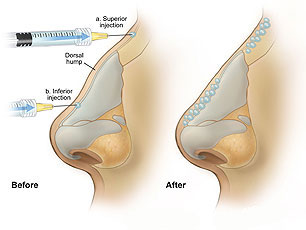
What is sometimes called a “five‑minute nose job” actually refers to filler injections in specific areas of the nose. In the illustration, “superior” refers to the upper part and “inferior” refers to the lower part. A nasal hump cannot truly be removed with fillers, but injecting filler above and below the hump can make it appear less noticeable.
The Use of Laser in Nose Surgery
In recent years, the term "laser nose job" has been widely promoted in the advertisements of some medical centers, and it is sometimes implied that laser can replace the usual methods of nose surgery. However, the scientific reality is that laser still does not have a defined and effective place as a main surgical tool in cosmetic nose surgery.Laser and Medical Advertising
Because of the appeal of the word "laser" in the public mind, it is sometimes used in medical advertisements in a way that creates the impression that laser nose surgery is a more advanced, painless, or non-surgical method. While in reality, laser does not play a decisive role in changing the shape of the nose, and most surgical steps are the same classic plastic surgery methods.Why Is Laser Nose Surgery an Empty Advertisement?
Despite technological advances in medicine, laser has still not found a special place in cosmetic nose surgery. Correcting the structure of the nose still requires precise surgical techniques on bone and cartilage. Therefore, people who are seeking nose surgery should base their decision on the surgeon's skill and experience, not merely on titles such as "laser nose surgery," which often have a marketing aspect.Crema e dispositivi per rimpicciolire il naso carnoso
Nel corso degli anni passati, vari prodotti come creme, gel e dispositivi per rimpicciolire il naso sono stati immessi sul mercato con l'aiuto di pubblicità satellitari ingannevoli, sostenendo di poter modificare le dimensioni e la forma del naso senza intervento chirurgico. Ma la realtà è che questi metodi non hanno alcuna reale funzione nel realizzare cambiamenti permanenti nella forma del naso e sono principalmente strumenti per il profitto.Creme per rimpicciolire il naso
Questi prodotti non hanno alcun effetto reale sulla struttura ossea e cartilaginea del naso.Anche se una persona notasse dei cambiamenti dopo l'uso di queste creme, questi cambiamenti sarebbero temporanei e tornerebbero rapidamente alla condizione iniziale.
Dispositivi per rimpicciolire il naso
Vari dispositivi sono disponibili sul mercato, solitamente progettati a forma di clip o strumenti correttivi. Questi dispositivi sostengono di poter applicare pressione sul naso e causarne il "cambiamento di forma".Nessuna reale efficacia: Questi dispositivi di solito non hanno alcun effetto positivo e permanente sulla struttura del naso. Le pressioni continue possono causare disagio o danni ai tessuti, ma non possono rimpicciolire le dimensioni del naso.
Possibilità di danni: L'uso scorretto di questi dispositivi può portare a danni ai tessuti interni o esterni del naso, infiammazione e problemi respiratori.

Devices, creams, and clips advertised in the market as nose reducers or shapers have no real effect and are deceptive marketing.
These Are Tools of Profit-Seeking and Are Not Endorsed by Dr. Hosnani
The use of such products and devices is more of an advertising technique to attract customers and increase sales. The companies producing these products usually focus on the feeling of dissatisfaction with the appearance of the nose and the desire to change it, making promises that are not scientific or real.Thread Nose Lift
Various methods have been introduced for correcting the shape of the nose without surgery, one of which is the thread nose lift. In this method, special absorbable threads are used that enter the nasal tissue through the skin and, by creating tension, attempt to slightly lift the nasal tip or change its shape. This method has attracted the attention of some individuals because of its quick performance and the absence of general anesthesia. However, the thread nose lift has important limitations and cannot replace nose surgery.Limitations of Thread Nose Lift
Despite extensive advertising, this method has significant limitations:1. Very limited changes
A thread nose lift can only create mild and temporary changes. This method is not able to correct a nasal hump, make the nose smaller, narrow the bones, or correct the cartilage structure.2. Temporary results
The threads used are usually absorbable and are gradually absorbed by the body over time. For this reason, the effect of this method usually lasts from a few months to at most about one or two years.3. No correction of structural problems
Problems such as a deviated nasal septum, a large nose, a bony hump, or breathing problems cannot be corrected with a thread lift. These problems can only be treated surgically.4. Possibility of complications
In some cases, complications such as inflammation, infection, thread displacement, irregularities in the shape of the nose, or the threads becoming visible under the skin may occur.Why Is a Thread Nose Lift Not a Substitute for Surgery?
Rhinoplasty (nose surgery) is a structural method in which the surgeon can correct the bone and cartilage of the nose, reduce the size of the nose, change the shape of the nasal tip, and, if necessary, also resolve breathing problems.In contrast, a thread nose lift works only by creating tension in the soft tissue and does not have the ability to make fundamental changes in the structure of the nose.
A thread nose lift may be a limited option for individuals seeking very minor and temporary changes, but it cannot replace nose surgery. For fundamental corrections in the shape of the nose or resolving its functional problems, nose surgery remains the most effective and durable method. Decision-making in this regard should be done with careful consultation with a specialist physician so that the most appropriate method is chosen for each individual.