




Using Rib Cartilage in Rhinoplasty
Dr. Hamidreza Hosnani
ENT Specialist | Rhinoplasty Surgeon in Tehran | Nose Surgery Specialist
In cases where the nasal framework has a severe cartilage deficiency and a large amount of cartilage is required, rib cartilage is the best option. People whose noses have been damaged in accidents, as well as individuals from certain ethnic groups such as African, some Afghan, and East Asian populations who may naturally have less cartilage, may benefit from rib cartilage grafts. Rib cartilage is harvested through a small incision in the chest, shaped to resemble the nasal structure, and then fixed onto the nasal bones.
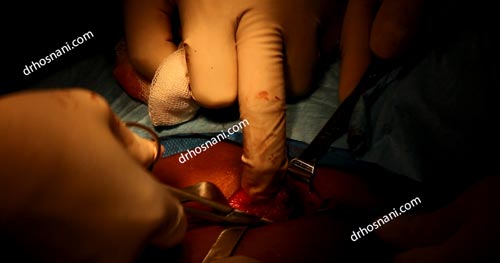
Harvesting Cartilage from the Rib for the Patient’s Nose Revision
Rib Cartilage: The Gold Standard in Complex Rhinoplasty
Clinical Indications for Autologous Rib Grafts
When the nasal anatomy exhibits significant cartilaginous deficits, the most reliable source for reconstruction is the patient's own rib cartilage. This necessity frequently arises in cases involving trauma, failed previous surgeries, or ethnic variations where the natural nasal framework lacks sufficient growth, such as in certain East Asian, African, or Middle Eastern phenotypes.In Dr. Hosnani’s professional practice, relying on autologous tissue is the cornerstone of reconstructive success. He maintains that when structural support is compromised, the rib graft provides an unparalleled foundation that artificial materials simply cannot replicate.
Why Autologous Tissue is Preferred
Extracting cartilage from the ribs—typically a small 4-5 cm incision—allows for the procurement of sufficient tissue without long-term negative impacts on the chest wall. While alternative sources like ear cartilage exist, they are often limited in volume and better suited for simpler, secondary refinements.Conversely, while synthetic or donor-irradiated cartilages offer initial aesthetic improvement, they carry risks such as infection or extrusion. Therefore, autologous rib graft remains the safest and most effective choice for sustainable outcomes.
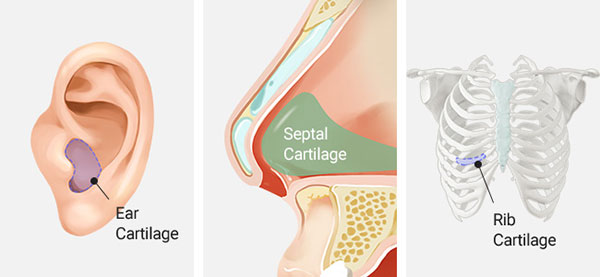
In rhinoplasty, cartilage grafts are sometimes used to strengthen or reconstruct the nasal structure. These grafts are usually taken from three main sources in the patient’s own body: septal cartilage, ear cartilage, and rib cartilage. Septal cartilage, taken from the middle wall of the nose, is the most common and suitable source because it is located in the same surgical area, has good strength, and can usually be harvested without changing the external appearance of the nose. If septal cartilage is insufficient, ear cartilage may be used; it is more flexible and is often useful for refining the nasal tip or delicate areas. In cases requiring greater volume and strength, such as revision surgeries or extensive reconstructions, rib cartilage is used because it provides a large amount of strong structural support.
The Surgical Procedure and Harvesting
Surgical Technique and Precision
The harvesting procedure typically involves the 6th rib, a minimal extraction that results in no functional impairment. Experienced surgeons such as Dr. Hosnani emphasize that if the surgical technique is precise, the recovery is remarkably manageable, with negligible long-term complications.Based on Dr. Hosnani’s extensive experience, the key to a complication-free harvest lies in meticulous dissection and adherence to the natural planes of the chest wall, ensuring the patient's comfort post-surgery.
Shaping the Graft for Aesthetic Outcome
Once harvested, the cartilage is carefully shaped. The procedure typically involves the open approach, providing the surgeon with complete visual control over the nasal architecture.Expert practitioners like Dr. Hosnani utilize this technique to build a structural integrity that supports the nose against the forces of healing and time. This methodology allows for the correction of nasal valves, strengthening of the columella, and precise restructuring of the dorsal bridge.
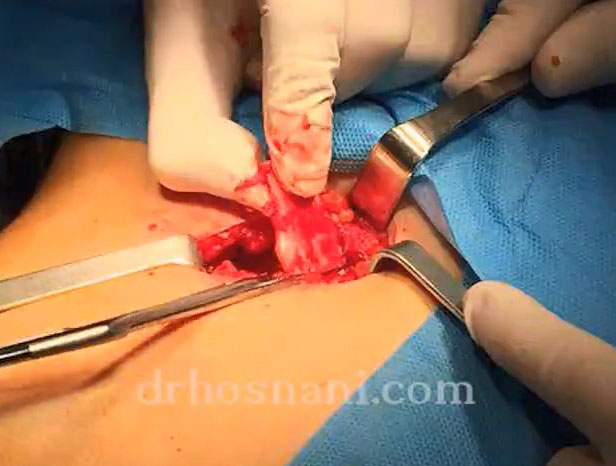
The surgeon makes a small incision, usually about two to three centimeters, in the inframammary fold or chest area to access the rib cartilage and harvest the required amount.
⚠️ Warning: This image contains surgical content!
Click to view
Click to view
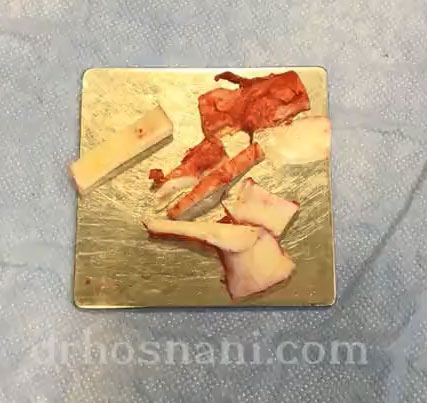
Rib cartilage pieces being cut and shaped.
Management and Post-Operative Care
Nasal Recovery Guidelines
Recovery protocols mirror standard rhinoplasty guidelines, with added attention to the donor site. Patients must adhere strictly to splinting and taping instructions while avoiding physical impact.Managing edema through nasal function preservation techniques and dietary adjustments—such as reducing sodium intake—are essential components of the post-operative regimen.
Monitoring the Donor Site
The chest incision site requires careful hygiene. Accomplished surgeons like Dr. Hosnani advise patients to keep the dressing clean and dry and to avoid strenuous physical activities or sudden torso movements during the initial healing phase.As observed by Dr. Hosnani, the patient's adherence to post-operative restrictions is as vital as the surgery itself in ensuring the long-term stability of the reconstructed nose.
Identifying the Ideal Candidate
Complex Revision Rhinoplasty
Patients who have undergone multiple failed surgeries, resulting in depleted native cartilage, are primary candidates for this procedure. Revision rhinoplasty requires a donor source with high volume and structural rigidity, making the rib the definitive solution.Congenital Nasal Hypoplasia
Those born with significant structural deficiencies, such as those associated with cleft lip, or individuals suffering from severe aesthetic standards deviations, benefit immensely from the robustness of rib grafts.The ability to customize the graft enables the surgeon to achieve optimal results that are both functionally sound and aesthetically pleasing, restoring the patient's confidence.