




Preservation Rhinoplasty
Dr. Hamidreza Hosnani
ENT Specialist | Rhinoplasty Surgeon in Tehran | Nose Surgery Specialist
Preservation rhinoplasty is a modern surgical technique that emphasizes preserving as much of the natural nasal anatomy as possible rather than aggressively removing tissue. Unlike traditional rhinoplasty, which was often reductive and involved extensive cutting of cartilage and bone, this technique focuses on minimizing incisions and preserving soft tissue structures. The goal is to achieve natural results with less swelling, faster recovery, and fewer complications such as breathing problems. The method often includes specialized osteotomies around the Webster triangle and the tripod structure of the nasal pyramid.
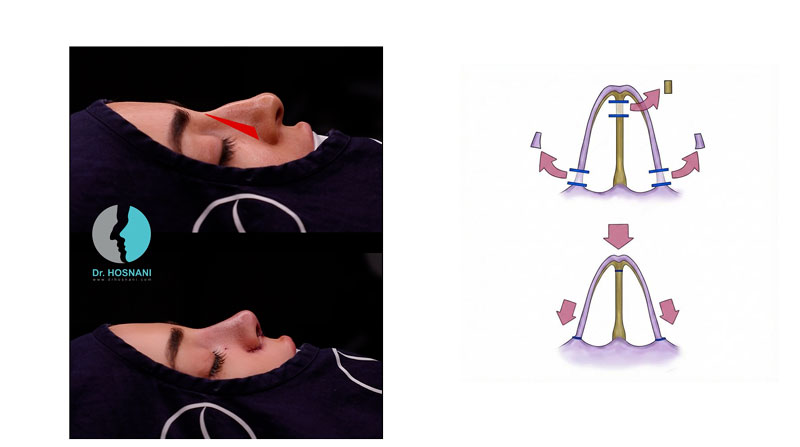
Preservation rhinoplasty is a technique in which the main nasal structures, such as the bones and cartilages of the nasal bridge, are preserved as much as possible so that the natural appearance of the nose is maintained and postoperative swelling and recovery time may be reduced. This technique is suitable for noses with mild to moderate humps and without severe deviation that do not require extensive structural changes. According to Dr. Hosnani, it is selected when the patient’s anatomy allows the desired aesthetic and functional result to be achieved without extensive structural removal.
Video Structural vs. Preservation Rhinoplasty: What's the Difference? | Dr. Hosnani
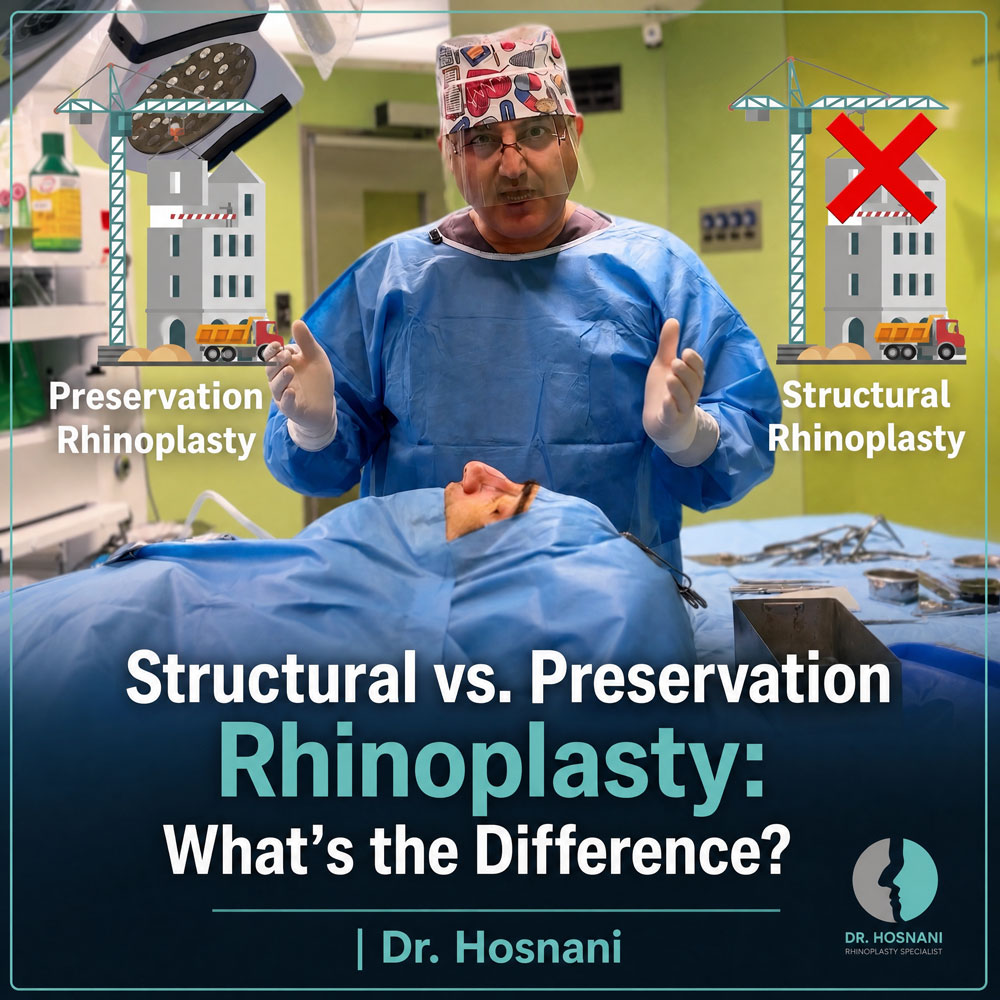
Video Description
In this educational video, Dr. Hosnani explains the technical differences between two major rhinoplasty approaches: Structural and Preservation surgery. He uses a helpful analogy, describing Structural rhinoplasty as removing the top floors of a building (shaving down the hump), while Preservation rhinoplasty acts like removing the bottom floors to lower the entire structure. Dr. Hosnani emphasizes that neither method is inherently superior; rather, the success of the surgery depends on the surgeon's expertise and the patient's specific needs. When performed correctly, both techniques offer excellent, comparable aesthetic results.
What Is Preservation Rhinoplasty?
Preservation rhinoplasty is a modern technique designed to preserve the natural structures of the nose as much as possible. Unlike older methods in which the nasal hump was shaved and then reconstructed, in this technique:◆ The nasal dorsal hump is not removed. Instead, the entire nasal dorsum is lowered a few millimeters using the Push‑down or Let‑down technique.
◆ The tip cartilages remain as untouched as possible.
◆ The septum (nasal septum) is modified conservatively rather than extensively removed.
◆ Natural structures and ligamentous attachments are preserved to create a “natural” and “unoperated” appearance.
Advantages of Preservation Rhinoplasty
✔ Produces very natural results without an “operated” look✔ Reduced swelling and bruising due to less tissue manipulation
✔ Faster recovery and shorter healing period
✔ Better preservation of breathing function
✔ Reduced need for cartilage or bone grafts
✔ Long‑term stability of the nasal dorsum
Limitations
Preservation rhinoplasty is not suitable for all patients. The following conditions may limit the use of this technique:✗ Very large or irregular humps
✗ Severe nasal bone deviation
✗ Revision rhinoplasty cases (secondary or tertiary surgeries)
✗ Severe cartilage deformities
✗ Very thick nasal skin that requires significant modification of the nasal tip
What Is Structural Rhinoplasty?
Structural rhinoplasty is an approach in which the nose is reconstructed to create a new, strong, and symmetrical framework. In this method:■ The dorsal hump is completely removed.
■ Cartilage structures are precisely reshaped, strengthened, or replaced.
■ Cartilage grafts (usually taken from the septum) are used to shape and reinforce the nasal tip.
■ Ligaments are reconstructed and the nose is guided to the desired position.
Advantages of Structural Rhinoplasty
✔ Suitable for a wide range of nasal problems (bony, fleshy, deviated, revision cases)✔ Allows precise and customized correction of the nasal tip
✔ Provides long‑term structural support, especially in thick‑skinned noses
✔ Gives the surgeon full control over the final nasal shape
✔ Ideal for complex cases requiring significant correction
Limitations
✗ Slightly longer recovery period✗ Greater possibility of bruising and swelling
✗ Greater need for grafts
✗ Technically demanding and requires significant surgical experience
What Is Webster’s Triangle?
Webster’s triangle is a small but important bony region located at the base of the lateral wall of the nose. It is named after the surgeon Robert Webster. This triangle is bounded by:• The piriform aperture anteriorly
• The nasomaxillary suture (junction between the maxilla and nasal bones) superiorly
• The attachment of the inferior turbinate inferiorly webster triangle
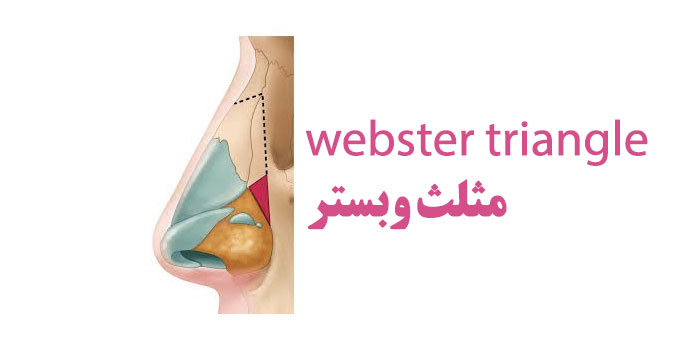
The Webster triangle is an area in the middle portion of the nasal bridge where the dorsal aesthetic lines meet the lateral nasal contours. If this region becomes overly depressed, protruded, or irregular, it can create unwanted shadows and an artificial appearance. Correcting this area requires balanced hump reduction, preservation of natural contour lines, controlled bone reshaping, and sometimes the use of delicate grafts to smooth the surface. According to Dr. Hosnani’s surgical techniques, creating a soft and symmetrical contour in this triangle helps the nasal bridge appear more natural and prevents sharp lines or unwanted depressions.
• Rocker deformity (a visible rocking movement of the nasal bones after surgery)
• Medialization of the inferior turbinate (movement inward that narrows the airway)
• Collapse of the internal nasal valve
What Are the Three Pillars of the Nasal Pyramid?
The nasal pyramid refers to the bony roof forming the upper part of the nose, which resembles an inverted pyramid. This structure is anchored to the skull at three main points that act as support points during surgery.These points include:
• The bilateral piriform apertures: two oval openings at the base of the nostrils on each side, where the nasal bones attach to the maxilla (upper jaw). These form the lower lateral pillars.
• The nasofrontal suture (junction): the superior central pillar where the nasal bones meet the frontal bone of the forehead.
• In preservation rhinoplasty, lateral osteotomies (cuts along the sides of the nasal bones) are carefully planned to pass through these three pillars, allowing controlled mobilization of the nasal pyramid without disrupting the dorsal aesthetic lines.
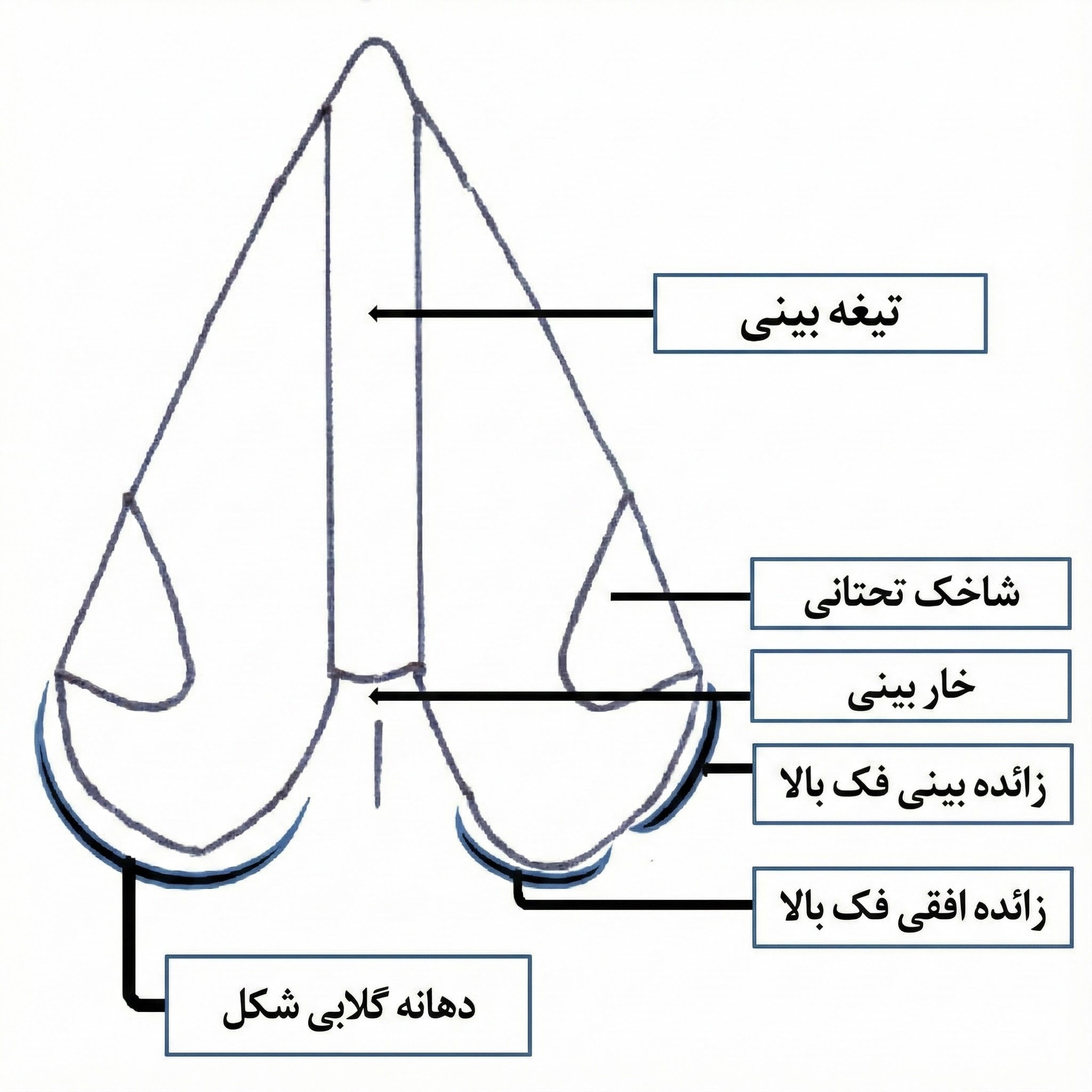
The nasal pyramid refers to the three‑dimensional structure of the middle and upper part of the nose, which is formed by the nasal bones in the upper portion and the upper lateral cartilages in the lower part. This structure determines the overall shape of the nasal bridge as well as the width and height of the nose. It plays an important role both in facial aesthetics and in proper airflow through the nose, because any narrowing, fracture, or asymmetry in this region can affect not only the appearance of the nose but also breathing function.
Tip Plasty in Preservation Rhinoplasty
In addition to dorsal hump surgery, the modern preservation technique differs from structural methods in tip plasty (nasal tip surgery) as well. Tip plasty focuses on improving the shape, projection (forward position), rotation, and symmetry of the nasal tip. This is the most delicate part of rhinoplasty because the nasal tip plays a key role in overall facial aesthetics. Two main approaches exist: The structural approach focuses on rebuilding and strengthening the nasal structure using graft materials. The preservation approach emphasizes maintaining natural anatomical elements with minimal intervention. The preservation approach in tip plasty, used by surgeons such as Dr. Hamidreza Hosnani, focuses on maintaining natural anatomy and views the nose as a delicate ecosystem that should be preserved without major disruption.
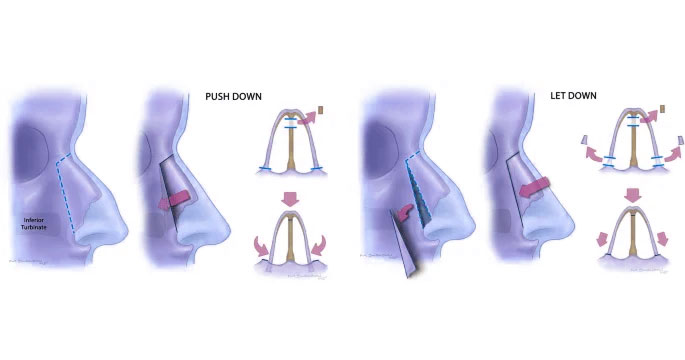
In the push‑up technique, the nasal bridge is elevated and repositioned as a single unit without removing bone. This method is suitable in cases where only mild to moderate reduction of the nasal bridge height is required and the bony structure is relatively delicate. In contrast, in the let‑down technique, the side portions of the nasal bones are slightly reshaped and lowered so that the entire nasal bridge is reduced in height in a more uniform and natural way.