




Deviated and Crooked Nose
Dr. Hamidreza Hosnani
ENT Specialist | Rhinoplasty Surgeon in Tehran | Nose Surgery Specialist
A deviated septum is different from a crooked nose. The deviation of the internal nasal septum is sometimes mistaken for the external crooked appearance of the nose. Inside the nose there is a thin vertical plate called the septum that acts like the central pole of a tent and helps support the structure of the nose.
Septal deviation is different from a crooked nose. Correcting a crooked nose is a cosmetic procedure that can be done with rhinoplasty, and correction of septal deviation can be performed at the same time.
What Is the Difference Between a Deviated Septum and a Crooked Nose?
The difference between a deviated septum and a crooked nose is important because septal deviation is considered a medical procedure and health insurance companies may cover its cost, whereas correction of a crooked nose is considered cosmetic surgery and is not covered by health insurance.There are three situations:
•
If the middle partition of the nose is crooked and this crookedness blocks one or both nasal passages, this is called a deviated septum. Both regular insurance and supplementary insurance usually cover the cost of septal deviation surgery.
• If a person’s middle nasal partition is crooked and, in parallel with it, the entire nasal structure is also crooked, but neither nasal passage is blocked, this is no longer considered a medical procedure and must be corrected with cosmetic rhinoplasty. This is because the entire nasal pyramid must be repositioned, and correcting the middle partition alone will not solve the patient’s problem.
• There is also another situation: the entire nasal pyramid is crooked, and the middle nasal partition is also crooked in a way that blocks the nasal passages. In this case, insurance companies should accept the part of the surgery related to the middle nasal partition. Unfortunately, at present, insurance companies do not accept this because cosmetic rhinoplasty is performed at the same time. This issue will need to be clarified in the future.
• If a person’s middle nasal partition is crooked and, in parallel with it, the entire nasal structure is also crooked, but neither nasal passage is blocked, this is no longer considered a medical procedure and must be corrected with cosmetic rhinoplasty. This is because the entire nasal pyramid must be repositioned, and correcting the middle partition alone will not solve the patient’s problem.
• There is also another situation: the entire nasal pyramid is crooked, and the middle nasal partition is also crooked in a way that blocks the nasal passages. In this case, insurance companies should accept the part of the surgery related to the middle nasal partition. Unfortunately, at present, insurance companies do not accept this because cosmetic rhinoplasty is performed at the same time. This issue will need to be clarified in the future.
Do All So-Called Deviated Noses Need Surgery?
First, nasal deviation must be defined carefully.
A deviated septum is different from a crooked nose. A deviated septum means that the internal nasal septum is crooked, not that the nose itself is crooked. The internal septum is a thin vertical plate that gives the nose its shape, much like the center pole of a tent that keeps it standing. This vertical plate may sometimes deviate to the left or right. In this situation, the person is said to have a deviated septum.
Please note that septal deviation is an internal problem and may not be visible from the outside.
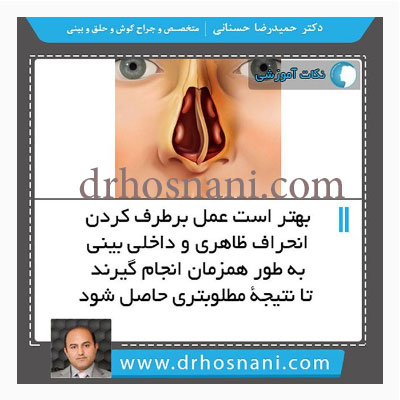
It is better to correct both the external crookedness and the internal deviation of the nose in the same surgery. Simultaneous correction improves both facial symmetry and breathing, whereas separate procedures may leave breathing problems unresolved.
Crooked Nose
The nose is a three-dimensional structure roughly shaped like a pyramid. Sometimes this entire pyramid grows crooked. A crooked nose refers to deviation of the entire nasal pyramid. In this situation, the nose appears crooked from the outside. Noses that look crooked externally are corrected using cosmetic rhinoplasty techniques, and insurance companies do not cover the cost. If the middle septum has deviated together with the entire nose, the person may not have breathing problems. Such a person has only an aesthetic nasal concern and needs cosmetic rhinoplasty only if they are dissatisfied with their appearance. In this situation, the middle septum is also straightened at the same time during cosmetic rhinoplasty so that, after the whole nasal pyramid is straightened, the septum will not remain crooked relative to the overall nasal structure. Otherwise, breathing problems may occur. If the nose is crooked and the middle septum is also disproportionately deviated and twisted, the person has both an aesthetic problem and a breathing problem. In this situation, the surgeon must straighten the middle septum to restore breathing while also correcting the external crookedness of the nose. 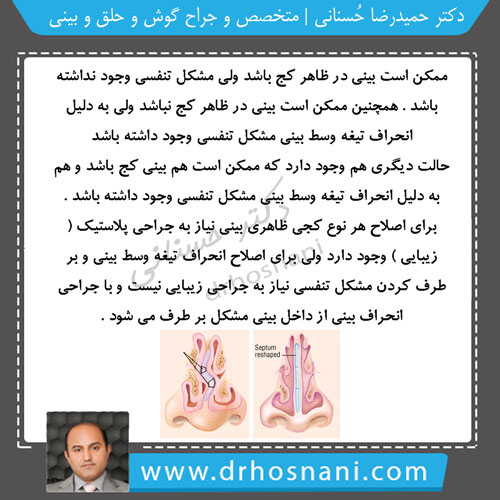
A Crooked Nose Is Different from a Deviated Septum; the Nose May Look Straight but Still Cause Breathing Problems Due to Septal Deviation
Cost of Treating Septal Deviation Without Plastic Surgery
Surgery for deviation of the internal nasal septum without plastic surgery is possible. The cost of correcting internal septal deviation is 1.5 million tomans, and supplementary insurance companies pay approximately 600 thousand to 1 million tomans of that amount.Simultaneous Treatment of External and Internal Nasal Deviation
It is possible to correct both external and internal nasal deviation at the same time, and it is better to perform these two procedures together to achieve a better result. In this case, supplementary insurance still only covers the cost of correcting the nasal septal deviation.Before and After Photo Gallery: Correction of Nasal Deviation
