




Open Rhinoplasty Technique
Dr. Hamidreza Hosnani
ENT Specialist | Rhinoplasty Surgeon in Tehran | Nose Surgery Specialist
In open rhinoplasty, a small incision is made on the columella (the thin skin between the two nostrils), and the skin of the nose is completely lifted so that the surgeon has a direct and extensive view of the cartilaginous and bony skeleton. According to Dr. Hosnani, this method is more suitable for complex cases such as fleshy noses, cases requiring cartilage reinforcement, severe nasal tip correction, or revision surgeries, because it provides greater precision and control in shaping the tip and creating symmetry, and the incision mark usually becomes very faint and almost invisible after a few months.
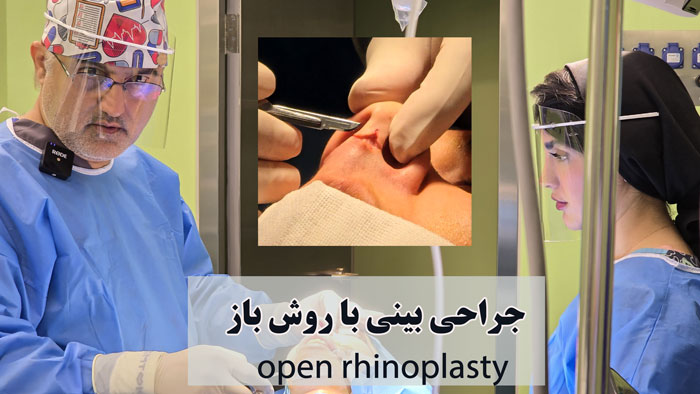
Open rhinoplasty is a technique in which, in addition to internal nasal incisions, a small incision is made on the columella so that the nasal skin can be lifted and the surgeon can directly visualize the bone and cartilage framework.
the bones,
the nasal septum,
the soft tissues
to be fully exposed. Because of this direct visibility, surgical precision increases and complex corrections become possible.
Steps of Open Rhinoplasty
1. AnesthesiaThe operation is usually performed under general anesthesia.
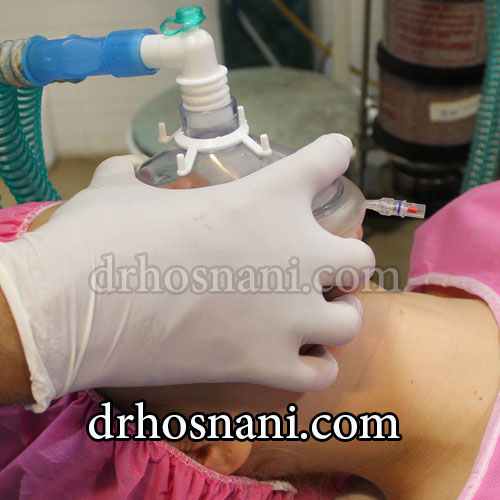
Anesthesia in Dr. Hosnani’s Operating Room Is Very Comfortable and Has Minimal Side Effects
A delicate incision is made in the middle of the columella. This incision is only a few millimeters long and becomes almost invisible after healing.
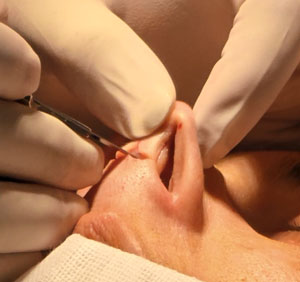
In open rhinoplasty a small incision is made on the columella, the narrow strip of skin between the nostrils, allowing the surgeon to lift the nasal skin and obtain direct visibility of the cartilage and bone structures.
The skin is gently separated from the nasal framework so that the internal structures are fully visible.
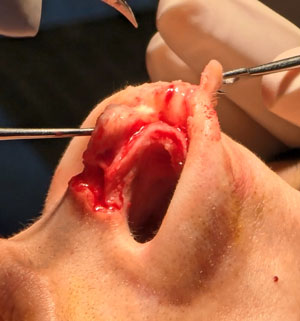
In open rhinoplasty, after the columella incision and internal nasal incisions are made, the nasal skin is carefully elevated from the underlying cartilage and bone framework so that the surgeon has full and direct visibility of the internal nasal structure.
⚠️ Warning: This image contains surgical content!
Click to view
Click to view
At this stage, the surgeon can:
✔ remove the hump
✔ reshape the bones
✔ strengthen or reduce the cartilages
✔ straighten a deviated septum
✔ refine the nasal tip with high precision
✔ place cartilage grafts
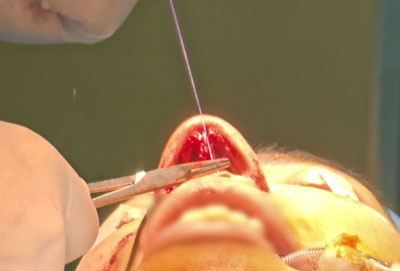
In cartilage shaping using suture techniques, the surgeon reshapes the cartilage using delicate sutures rather than removing large amounts of cartilage, allowing the new form to be stabilized while preserving structural strength.
⚠️ Warning: This image contains surgical content!
Click to view
Click to view
At the end of the procedure, the skin is placed back in its position and the columellar incision is closed with fine sutures.
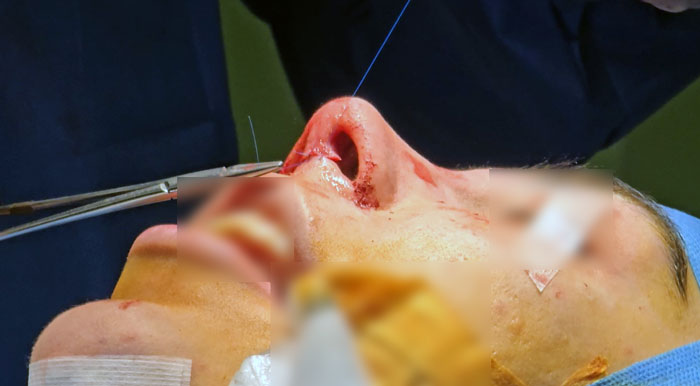
The stage of suturing the columella incision after reshaping the nose is performed using very delicate stitches. Dr. Hosnani places these sutures carefully so that the scar becomes almost invisible and gradually fades within a few weeks.
⚠️ Warning: This image contains surgical content!
Click to view
Click to view
A splint is placed on the nose to keep the bones stable.
Advantages of Open Rhinoplasty
1. Wide and Direct View of Nasal Structures
The greatest advantage of this technique is complete visibility, which allows the surgeon to perform the following with maximum precision:✔ complex nasal tip correction
✔ straightening a deviated septum
✔ improving symmetry
✔ placing grafts
✔ revising noses that have previously been operated on
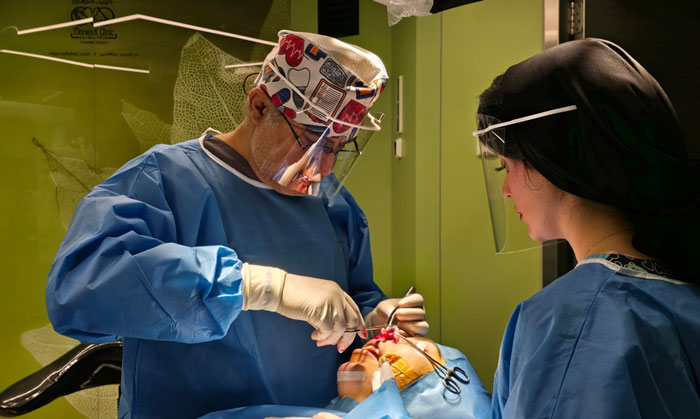
In open rhinoplasty, the internal structure of the nose is fully exposed, allowing the surgeon to directly observe the nasal bones, cartilages, and tip structures without limitation. This direct visualization provides greater precision when reshaping and reconstructing the nasal framework.
⚠️ Warning: This image contains surgical content!
Click to view
Click to view
2. The Most Suitable Method for Difficult and Complex Noses
The open technique is the best option for the following types:✔ fleshy noses
✔ bony noses with severe deviation
✔ wide or drooping nasal tips
✔ noses that require cartilage grafting
✔ revision rhinoplasty
✔ damaged or deformed noses
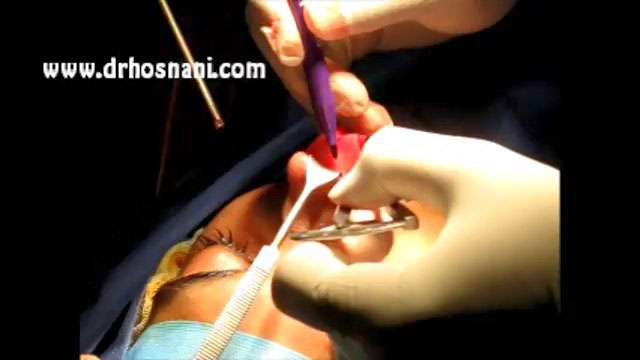
Open rhinoplasty.
⚠️ Warning: This image contains surgical content!
Click to view
Click to view
3. Precise Nasal Tip Shaping
In the closed technique, control over the nasal tip is more limited.However, in the open technique, the surgeon can raise or lower the tip, narrow it, strengthen weak cartilages, correct drooping, and perform precise modeling.
4. More Stable Results
Because the surgeon can reinforce the nasal structure more effectively, results with the open technique are usually more stable and standardized.Disadvantages and Limitations of Open Rhinoplasty
1. More Swelling
Because the skin is separated, nasal swelling is slightly greater and lasts somewhat longer in the open technique compared with the closed technique.However, after a few months, no noticeable difference remains.
2. A Small Columellar Incision
A fine line is created on the columella, but:✔ it is very small
✔ with proper technique, it usually becomes unnoticeable
✔ after a few months, it blends with the skin color
3. Longer Operating Time
Because the work is more extensive, the operation usually takes 15 to 30 minutes longer than the closed technique.How Visible Is the Columellar Scar?
The columellar incision is one of the concerns patients often have, but in reality:the incision is very delicate
it is located in a natural skin crease
it is closed with precise sutures
it becomes almost faded after 2 to 3 months
in most patients, even close family members do not notice it.
Recovery and Healing After Open Rhinoplasty
1. During the First Week, the Splint Remains on the Nose
Bruising around the eyes may be present, and swelling is slightly greater than with the closed technique.2. From the Second to the Fourth Week
Most bruising disappearsSwelling decreases
Daily activities can be resumed
3. From the First to the Third Month
About 60 to 70 percent of swelling decreasesThe shape of the nose becomes clearer
4. One Year After Surgery
The final result becomes completely visibleThe nasal tip changes the most during this period
Who Is the Best Candidate for Open Rhinoplasty?
This method is suitable for individuals who:have a fleshy nose
have a wide, large, or drooping nasal tip
have a crooked or deviated nasal septum
need complex corrections
have previously undergone rhinoplasty and need revision
want high surgical precision and control
Is closed rhinoplasty better or open rhinoplasty?
No method is absolutely superior; the choice depends on the type of nose and the patient’s goals.
In General:
For simple and straightforward noses, the closed technique is suitable.For complex, fleshy, deviated, or revision noses, the open technique is the best choice.
Most experienced surgeons prefer the open technique for precise procedures and to ensure stable results.