



Rhinoplasty Differences Across Ethnicities
Dr. Hamidreza Hosnani
In general, four main ethnic groups visit Dr. Hosnani for rhinoplasty: people from the Middle East, East Asian and Afghan ethnic groups, Europeans, and Africans. Dr. Hosnani adapts and personalizes rhinoplasty techniques according to the characteristics of each ethnic group.
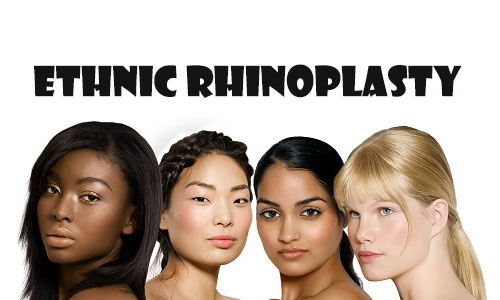
One of the questions frequently asked of Dr. Hosnani on television programs and also in online consultations is about rhinoplasty for different ethnic groups, or ethnic rhinoplasty. Dr. Hosnani is skilled in surgery for different ethnicities. People of various ethnic backgrounds travel from foreign countries to Iran to undergo rhinoplasty with Dr. Hosnani.
In general, Dr. Hosnani’s international patients are divided into four categories. The surgical techniques for each group are unique, and each category also has its own subgroups.
Middle Eastern Ethnic Rhinoplasty
1- The first group consists of Middle Eastern Arabs who travel to Iran both from Persian Gulf countries and from European countries. Contrary to the common assumption that Arab noses are usually fleshy, many of them have large, bony noses. Therefore, not everyone can be operated on using a single formula. Although problems such as a nasal hump, thick nasal skin, and nasal width are common among many patients of this ethnicity, each person’s nose has its own unique anatomy. Removing too much cartilage from the patient’s nose can lead to a pinched nasal tip and an unnatural-looking nose. Of course, the patient’s opinion is also important, and during the consultation session, the patient is asked about their taste and whether they prefer a natural or semi-fantasy nose.Video: Why Do Iraqi Girls Choose Dr. Hosnani in Iran?
In the heart of Tehran, somewhere in the city center, a clinic named Maryam was filled with the passionate voice of Nancy Ajram, with the bustle of music and hope; a cheerful, energetic space full of anticipation. Nasrin Davoodi, a 22-year-old girl from Iraq, had set her heart on cosmetic surgery and had traveled to Iran for this important decision; with a heart full of dreams and eyes searching in the mirror for renewed self-confidence. On the same day, Zahra Amiri, a 23-year-old girl from Iraq, had also chosen Iran again to become more beautiful. It was her second time coming to this country for cosmetic surgery, because there was something here she could not find elsewhere: skill, honesty, and a feeling of safety. Iran now hosts hundreds of thousands of medical tourists; experienced surgeons, modern equipment, and costs that are remarkable compared with the quality, to the point that statistics say the number has grown from twenty thousand people fifteen years ago to more than three hundred thousand today. Most of them are Iraqi, but the story is not only about numbers; it is the story of hearts that are warmed again in this country. The Ministry of Health says that last year, more than one billion dollars entered the country through this path; at a time when sanctions exert pressure, the presence of these people who have come to repair their appearance and perhaps part of their soul has painted a color of hope on hospital walls. Physicians such as Dr. Hamid Reza Hosnani had operated on three Iraqi patients that morning; without stopping, with precision, and with encouragement. When COVID subsided, a wave of Arab patients returned to Iran, because they knew that here there is still a hand that works with precision, an eye that works with understanding, and a heart that works with humanity. Even medical tourism guides are now being trained; like Ammar Khadem Hossein, an Iranian-Iraqi man who does his work with love. But everything is still not without difficulty; the lack of international banking connections is a major problem. Even so, Nasrin says: it is still worth it; I will come again, because here, for me, there is something that exists nowhere else.
East Asian and Afghan Ethnic Rhinoplasty
2- The second group consists of Asian and Afghan ethnicities who come from eastern countries and Afghanistan. These individuals usually have a low nasal bridge and a wide nasal tip, which results in large nostrils. In the past, silicone implants were used to correct the problem of a low nasal bridge. Although this method was successful in many cases, in 10 to 15 percent of patients it led to infection, requiring the physician to remove the implant or prosthesis from the nose. For reshaping this type of nose, Dr. Hosnani uses grafted cartilage taken from the patient’s own body to strengthen the nasal bridge. In this way, the use of silicone and other foreign or synthetic materials inside the patient’s body is avoided. These patients are usually operated on using cartilage taken from the area behind the ear or from the rib.European Ethnic Rhinoplasty
3- The third group consists of European ethnicities who mainly travel to Iran from Spain, France, and England. Australians are also included in this category. The characteristic features of European noses are that their nasal bridge is straight and narrow, the nasal tip is prominent and projects outward, and the nasal wings are also prominent. According to aesthetic experts, the features of a beautiful European white woman include soft, clear, fair skin, large eyes that are slightly far apart, and long eyelashes. A beautiful European nose should be small and delicate, and the cheekbones should be prominent. Considering that the standard beauty features from the European point of view are the points mentioned above, Dr. Hosnani tries, when operating on European noses, to perform surgery in a way that brings them closer to their own standard aesthetic features.African and Black Ethnic Rhinoplasty
4- The fourth group consists of African and Black ethnicities. African noses usually have the same problem as Asian noses; that is, the nasal bridge has low height and the nasal tip is wide. The difference is that their cartilages are weaker and the nasal skin is usually thicker. Dr. Hosnani’s method for operating on African noses is to use grafted cartilage taken from the patient’s rib.