




Is Your Nose Too Small After Surgery? How to Enlarge It?
Dr. Hamidreza Hosnani
ENT Specialist | Rhinoplasty Surgeon in Tehran | Nose Surgery Specialist
Augmentation (increasing the size) of the nose can be performed for individuals whose noses have become excessively small following previous surgeries. Some individuals have had their noses reduced so much after previous surgeries that they suffer from respiratory problems.

Nasal augmentation surgery, unlike reductive rhinoplasty, is performed for individuals who have a small, sunken, or under‑projected nose. In this procedure, cartilage grafts (usually taken from the patient’s own nasal septum, ear, or rib) or in some cases synthetic implants are used to increase the height of the nasal bridge, elevate the nasal tip, or strengthen the overall nasal structure. This type of surgery is more commonly performed in Asian noses, noses with congenital depressions, or noses that have become overly reduced after previous surgery. A natural result depends on carefully controlled augmentation that remains harmonious with the rest of the facial features.
Nose Enlargement with Surgery:
Some individuals develop breathing problems after previous nasal surgeries because their nose has become excessively small. In other cases, previous surgeries may have reduced the size of the nose so much that it no longer fits the proportions of the face and creates an undesirable appearance. These two groups of patients often seek surgical procedures to enlarge and reconstruct the nose.Enlarging noses that have been excessively reduced by previous surgeries:
Regardless of whether the previous surgeon’s style was to reduce the nose too much or whether the patient pressured the surgeon to make the nose extremely small, this approach is not considered acceptable. Nose reduction, if performed beyond a certain limit, is neither correct nor medically appropriate.
This does not mean that reducing large noses is always wrong. Some noses are very large and significantly affect facial beauty. In such cases, the nose can be reduced to the extent that it improves appearance without causing breathing or olfactory problems. However, nose reduction has clear standards, and surgeons are only allowed to reduce the nose within safe limits. If the reduction goes beyond these limits, the nasal tissues will inevitably be damaged, and breathing and sense of smell may be affected.
In addition, in some individuals excessive reduction not only causes breathing or smell problems but also disrupts facial harmony. When the nose becomes too small relative to the face, the overall beauty of the person can be negatively affected because the nose must remain within a standard and natural size range.
If the nose becomes smaller than this standard range, facial harmony is lost. People who look at the person may feel that something appears unusual or unbalanced, even if they cannot immediately identify the reason. This lack of harmony can reduce perceived attractiveness, and many of these individuals later seek surgery to enlarge their nose again.
The Goal Is Not to Make the Nose Excessively Large
Nose enlargement surgery does not mean making the nose so large that it again appears disproportionate. The goal is simply to bring the nose out of an abnormal, overly reduced state and return it to a natural and aesthetically balanced size.The aim is that when others look at the patient, the nose appears harmonious and natural rather than artificial. In many cases, the best result is when people simply feel that the face looks balanced without specifically noticing the surgery.
Therefore, the surgeon’s primary responsibility is to correct both breathing problems and aesthetic imbalance, restoring the nose to a normal and harmonious appearance.
How is nose enlargement surgery performed?
There are different methods for enlarging the nose, but the main principle is based on cartilage grafting. The nasal framework that has become too small must be reconstructed using grafted cartilage.
The surgeon harvests cartilage from other parts of the patient’s body and grafts it into the nose.
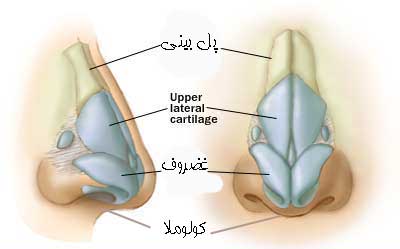
Nasal cartilages are divided into several main parts, each of which plays an important role in the shape and function of the nose. The upper lateral cartilages are located in the upper part of the nose beneath the nasal bones and contribute to the strength of the middle third of the nose. The lower lateral cartilages, or nasal tip cartilages, determine the shape of the nasal tip and alae and have a major effect on the final aesthetic form. The septal cartilage is located in the center of the nose and serves both as the main supportive structure of the nose and as an important source of cartilage grafts in surgery. In some cases, ear cartilage or even rib cartilage is used to repair or strengthen the nasal structure. The combination and health of these cartilages ensure the proper form, symmetry, and function of the nose.
Different Cartilage Sources
Synthetic Cartilage:
One option is artificial or synthetic cartilage. Synthetic materials can be durable, but their main drawback is the possibility of infection over time. In some cases, the implant may even protrude through the skin, causing serious complications. For this reason, the use of synthetic cartilage is generally not recommended.

Some surgeons use artificial implants for nasal reconstruction. Dr. Hosnani prefers using natural cartilage taken from the patient’s own body. Although artificial implants exist and may have acceptable short‑term results, their long‑term reliability remains uncertain, especially for young patients who may live many decades with them.
Homograft Cartilage:
Another cartilage source comes from individuals who have died due to various causes. Cartilage from these donors is removed, sterilized, and treated with radiation before being used in other patients. These grafts are known as homografts.Homograft cartilage usually does not cause the same complications as synthetic implants. Infection rates are generally lower, and the graft usually does not protrude through the skin. However, a major drawback is that homograft cartilage may gradually be absorbed by the body over about ten years. As a result, the nose may partially return to its previous shape. Because of this limitation, homograft cartilage is also not widely favored.
Another concern is the theoretical risk that diseases not yet identified by medical science could potentially be transmitted through donor tissue, since the cartilage originates from another person.
Autograft Cartilage:
The remaining and most preferred cartilage source is the patient’s own cartilage, known as an autograft. This cartilage is usually taken from behind the ear or from the rib.The best initial choice is often cartilage from behind the ear. Harvesting ear cartilage usually causes minimal complications. It does not significantly change the appearance of the ear, and most people cannot tell that cartilage has been taken. Hearing and ear function remain unaffected. A small incision is made behind the ear, and the risk of complications is very low.
However, ear cartilage may not provide a large enough quantity if the nose has been excessively reduced or if the nasal valves have become very narrow. In such cases, ear cartilage alone may not be sufficient for reconstruction.
Another option is rib cartilage. Rib cartilage is an excellent material because it provides a large amount of strong cartilage for rebuilding the nasal framework. It also avoids the complications associated with synthetic materials or donor grafts.
The main drawback is that a small scar—about three to four centimeters long—remains under the chest after the cartilage is harvested. Aside from this scar, rib cartilage generally does not cause major complications when the procedure is performed properly, and it can be very effective for reconstructing the nose.
Once the cartilage source is determined, the patient can be prepared for surgery. The surgeon lifts the nasal skin and reconstructs the nasal framework using the harvested cartilage. The nose is then enlarged and reshaped to match the proportions of the patient’s face. Finally, the skin is repositioned over the reconstructed framework.
After the healing period, the patient will have a nose that is larger, more proportional, and functionally improved in terms of breathing and smell, allowing them to return to a normal and confident life.
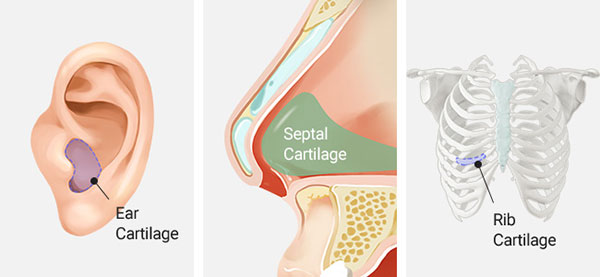
In rhinoplasty, cartilage grafts are sometimes used to strengthen or reconstruct the nasal structure. These grafts are usually taken from three main sources in the patient’s own body: septal cartilage, ear cartilage, and rib cartilage. Septal cartilage, taken from the middle wall of the nose, is the most common and suitable source because it is located in the same surgical area, has good strength, and can usually be harvested without changing the external appearance of the nose. If septal cartilage is insufficient, ear cartilage may be used; it is more flexible and is often useful for refining the nasal tip or delicate areas. In cases requiring greater volume and strength, such as revision surgeries or extensive reconstructions, rib cartilage is used because it provides a large amount of strong structural support.