




Rhinoplasty Sutures
Dr. Hamidreza Hosnani
ENT Specialist | Rhinoplasty Surgeon in Tehran | Nose Surgery Specialist
Two types of sutures are used in rhinoplasty. External incisions are closed with removable sutures, while absorbable sutures are used inside the nose. External stitches are usually removed seven days after surgery.
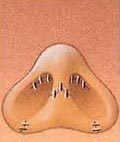
Internal Nasal Sutures
The second factor is the surgeon’s skill and precision. The more modern and refined the technique used by the surgeon to close the incision, the lower the chance that suture marks will remain. Iranian skin is usually slightly thick and somewhat darker than the skin of fair-skinned Europeans. For this reason, in most people, a very fine suture mark may remain. There are ointments and creams that can help reduce the appearance of these marks. These ointments and creams are quite effective and can fade suture marks to a great extent. For people who still have a slight remaining mark despite these measures, treatments such as laser therapy or removing a superficial layer of skin over the suture line can be used to make the mark less visible. If the suture mark is significant, plastic surgery techniques can be used to make it lighter. However, in people with thicker and darker skin, completely eliminating suture marks is usually not possible. Women can cover these marks with foundation, while men may need to accept a slight remaining mark. For those who cannot accept any suture mark at all and do not want any scar to remain after surgery, closed rhinoplasty techniques can be used. However, it should be kept in mind that closed rhinoplasty usually does not provide the same degree of precision and delicacy as open rhinoplasty, because the surgeon has less visibility. Therefore, in closed rhinoplasty, it is usually not possible to make the nose as refined as with open techniques.
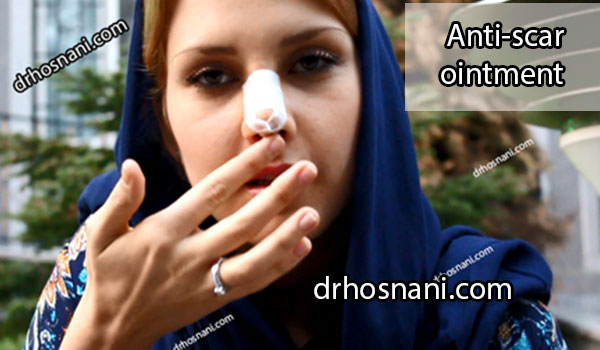
One week after rhinoplasty, once the sutures are removed, you may use anti‑scar ointments for two months or longer depending on your doctor’s recommendation. Apply a thin layer on the nasal skin.
Are Absorbable Sutures Better or Removable Sutures?
Absorbable sutures are used for the internal parts of the nose, while removable sutures are used to repair external incisions. The timing of absorbable suture disappearance is not fully controllable, but non-absorbable sutures can be removed at the proper time, usually after 7 days. For this reason, less scarring remains and the scar is smaller. Therefore, removable sutures are better than absorbable sutures for repairing external incisions.Video Why Does Your Nose Smell Bad After Surgery? | Dr. Hosnani Explains
Video Description
Experiencing a bad smell in your nose after rhinoplasty? Dr. Hosnani explains that the most common cause is the use of non-absorbable sutures beneath the nasal skin, which can sometimes penetrate the nasal mucosa. While temporary odors can occur with absorbable sutures, persistent bad smells often require professional intervention. Dr. Hosnani discusses how to manage this through nasal irrigation and antibiotics, or, if necessary, removing the non-absorbable sutures to fully resolve the issue.
When Are Rhinoplasty Sutures Removed?
This depends on whether the surgery was performed using the open or closed technique. Closed rhinoplasty does not require suture removal. Sutures placed in the lower part of the nose, called the columella, are removed after one week. Sutures around the nostril wings are removed after 9 or 10 days. Internal nasal sutures are absorbable and do not need to be removed. 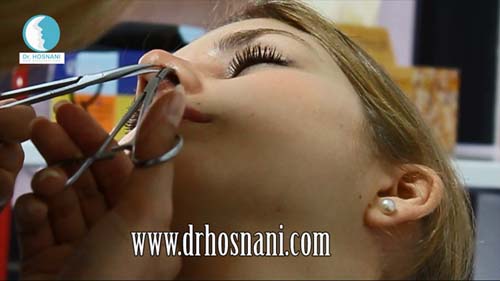
Surgical stitches (for rhinoplasty or facial plastic surgery) are removed one week after surgery.
Rhinoplasty: What Is the Difference Between Open and Closed Techniques?
In the closed technique, all incisions are made inside the nose. In the open technique, the main incision is made under the nose and then extended into the inside of the nose. The only difference between these two methods is the incision under the nose. Of course, to reduce the size of the nostril wings, whether in open or closed rhinoplasty, incisions need to be made on the sides of the nose. However, not many people need nostril wing reduction. 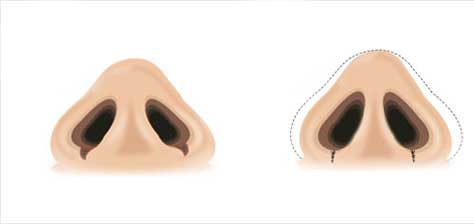
If the nose is wide, two incisions can be made in the nasal alae to reduce the width of the nose and the size of the nostrils.
Nostril Wing Sutures
Rhinoplasty is performed using two methods: open and closed. In closed rhinoplasty, all incisions and sutures are placed inside the nose. In the open technique, a small incision and suture are placed on the central base under the nose.Recovery is faster with the closed technique, but in the open technique, the surgeon has a greater ability to satisfy the patient’s expectations.
However, in both techniques, if the patient has large nostril wings, the surgeon inevitably has to open and reduce the sides of the nose. In these cases, a small suture mark may remain beside the nostril wings, and its extent depends on the person’s skin type. If the person has fair and delicate skin, the suture mark will be very minimal. The thicker and darker the skin is, the more likely the suture mark is to remain. Of course, the surgeon’s precision in repairing the sutures also plays a moderate role.
Sometimes the surgeon encounters patients who do not accept any suture mark beside the nose at all. In such cases, nostril wing reduction can be avoided, but the patient must accept having larger nostril wings.
Internal nasal sutures are usually absorbable. Absorbable sutures are typically used inside the nose, while non‑absorbable sutures may be used for external incisions. Absorbable sutures do not need removal and usually dissolve within three weeks to three months.
What Happens If a Suture Remains Inside the Nose?
In most cases, leaving sutures inside the nose does not cause a problem, but depending on the type of thread and the tissue conditions, several situations may occur: Absorbable sutures: Most internal nasal sutures are absorbable. These threads gradually break down through the body’s enzymes or hydrolysis and disappear on their own. If part of these threads is absorbed a little later, you may feel a foreign-body sensation or roughness inside the nose, which usually resolves over time without any special intervention.Non-Absorbable Sutures: If non-absorbable sutures are used, they remain in place. In many modern surgical techniques, these sutures are placed as buried sutures inside the tissue to permanently support the nasal structure and usually do not cause any problem.
Possible Complications — Rare: If the suture is located on the mucosal surface or its tip protrudes, it may irritate the mucosa and cause discharge, itching, or burning inside the nose. In rare cases, if the suture causes a tissue reaction, such as a small bump or granuloma, or if nasal discharge accumulates around it and creates an unpleasant odor, the surgeon can easily trim or remove the suture during follow-up visits.
Important Note: If you feel there is a suture inside your nose that causes pain, bleeding, or a persistent bad smell, the best approach is to avoid manipulating it and see your surgeon as soon as possible so it can be removed if necessary. Trying to pull out a suture on your own, especially during the first days after surgery, can damage structures that are still healing.
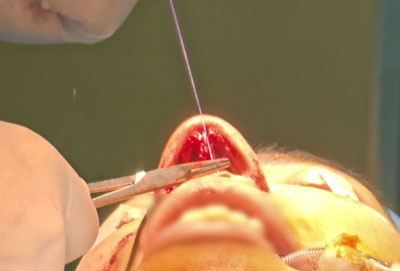
In cartilage shaping using suture techniques, the surgeon reshapes the cartilage using delicate sutures rather than removing large amounts of cartilage, allowing the new form to be stabilized while preserving structural strength.
⚠️ Warning: This image contains surgical content!
Click to view
Click to view
Does Removing Nasal Sutures Hurt?
Removing nasal sutures is usually not painful and feels more like a very mild pulling sensation or tickling inside the nose.Because the nasal mucosa is sensitive, you may sneeze or feel some discomfort, similar to having a hair stuck inside the nose, when the suture is removed. However, it is not a sharp or unbearable pain.
The surgeon or assistant removes the suture with delicate instruments in a very short moment, so the process takes very little time.
Surgical stitches (for rhinoplasty or facial plastic surgery) are removed one week after surgery.
Overall, most patients report that the worry before suture removal is much greater than the actual experience, and there is usually no need for special concern.
What Is the Suture on the Upper Nose For?
In rhinoplasty, using a suture in the nasal bridge area, as shown in the image below, is usually done for the following purposes:1. Stabilizing and Fixing Structures: After changes are made to the bone and cartilage of the nasal bridge, such as hump removal or correction of deviation, the surgeon may use this suture to ensure that the tissues stay in the correct new position and do not shift during the early healing period.
2. Closing Dead Space: This suture helps the nasal skin sit smoothly and evenly over the underlying bone-cartilage framework, known as skin redraping, and helps prevent blood or fluid accumulation, such as a seroma, in the space between the skin and nasal framework.
3. Helping Shape the Final Form: In some techniques, this suture allows the surgeon to adjust the contour line of the nasal bridge more precisely and prevent irregularities or localized swelling in that area. These sutures are usually part of the surgical protocol of surgeons who emphasize precise techniques so that the final result, like the image on the left, is smooth, symmetrical, and free of unwanted bumps. This suture is removed by the surgeon after the appropriate time has passed, and its mark gradually fades and disappears.