




Using Graft Cartilage in Rhinoplasty
Dr. Hamidreza Hosnani
ENT Specialist | Rhinoplasty Surgeon in Tehran | Nose Surgery Specialist
In rhinoplasty, graft cartilages are used to reshape and repair nasal structures. These cartilages may be taken from the patient’s own body, which are called autologous grafts. Surgeons may also use artificial cartilage. The ear and the rib are among the best sources of cartilage that can be harvested from the patient.
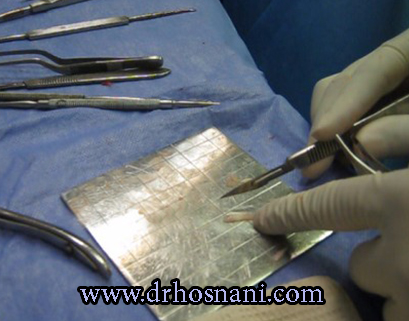
Dr. Hosnani shapes the cartilages taken from your nose or ear in the operating room and uses them during surgery. These cartilages are sometimes harvested from the patient's rib.
Grafts in Rhinoplasty
Definition and Surgical Importance
Grafts are pieces of tissue that are placed or implanted in a specific area of the body in order to restore form, reinforce structure, or correct a defect. Although several types of grafts exist in medicine, including skin and fat grafts, in rhinoplasty the discussion is primarily centered on cartilage grafts and, more rarely, bone grafts.In nasal surgery, grafts play an indispensable role in restoring harmony, improving function, and compensating for tissue deficiencies that may exist before surgery or arise during previous unsuccessful procedures.
Main Sources of Cartilage and Bone
The nasal septum, the cartilage behind the ear, and the rib are the principal sources for harvesting cartilage and preparing grafts. In unusual and highly specialized cases, bone may also be taken from the skull or pelvis.These donor sites are selected according to the nature of the deformity, the amount of support required, and the surgeon’s judgment regarding long-term stability.
According to Dr. Hosnani, the success of grafting in rhinoplasty depends not only on technical precision, but also on choosing the most suitable donor source for each individual nose.
Why Grafts Are Used
Correction of Depressions and Tissue Deficiencies
Depressions, contour irregularities, structural defects, and tissue loss are among the most common problems corrected with grafts. These issues may be present before surgery as a result of trauma, injury, or disease, or they may develop after an overly aggressive or poorly executed operation in which too much cartilage has been removed.In such situations, grafts are used to fill hollows, rebuild weakened areas, and restore a more balanced and functional nasal framework.
Preference for the Patient’s Own Tissue
In most cases, grafts are harvested from the patient’s own body. This approach is generally preferred because it offers a high degree of biological compatibility and dependable integration.Autologous cartilage is therefore favored whenever possible. Dr. Hosnani generally prefers cartilage obtained from the patient’s own tissues, with the nasal septum often serving as the first and most practical choice.
In Dr. Hosnani’s view, the patient’s own cartilage remains the most trustworthy material for nasal reconstruction because it offers superior compatibility, safety, and durability.
Common Donor Sites for Cartilage Grafts
Septal Cartilage as the Primary Choice
The cartilage of the nasal septum is commonly used because it is located within the operative field and can often provide an excellent source of firm and usable material. It is especially valuable in both primary and secondary rhinoplasty when moderate structural support is required.Its straight form and favorable strength make it highly suitable for many reconstructive and supportive applications.
Ear Cartilage and Its Practical Advantages
The auricle, or ear cartilage, is another major source for graft harvesting. Cartilage can be taken from behind the ear during surgery, and this is a relatively straightforward procedure that usually does not require any separate preoperative visit.Ear cartilage is particularly helpful when softer and more flexible material is needed, especially for delicate functional repairs rather than major structural reinforcement.
Rib Cartilage in Advanced Reconstruction
Harvesting rib cartilage is somewhat more demanding than taking cartilage from the septum or ear, yet it offers a rich and highly valuable source of material for extensive nasal reconstruction.When a large amount of graft material is needed, especially in difficult revision cases, rib cartilage can provide the strength and volume necessary for a reliable rebuild.
Drawing on Dr. Hosnani’s extensive experience, rib cartilage becomes especially important when the nose requires major structural restoration and smaller donor sources are no longer sufficient.
Donor Cartilage from Outside the Body
Processed Cadaveric Rib Cartilage
Some surgeons use cadaveric rib cartilage for the sake of convenience. Before use, this type of cartilage is irradiated and processed in specialized facilities, then sterilized, packaged, and delivered for surgical application.Prior to insertion, the surgeon usually reshapes and thins the cartilage so that it can be adapted to the patient’s nasal anatomy.
Dr. Hosnani’s Preference in Material Selection
Although cadaveric cartilage may be used in selected circumstances, Dr. Hosnani does not usually rely on this material. His preference is generally directed toward tissue obtained from the patient’s own body whenever feasible.This preference reflects a cautious and quality-driven philosophy intended to maximize predictability and minimize avoidable concerns related to graft behavior.
Dr. Hosnani maintains that while processed external graft materials may have a role in selected cases, self-derived tissue is usually the more dependable option for refined and lasting rhinoplasty outcomes.
Tip Support in Middle Eastern Noses
Weak Tip Cartilage and Nasal Drooping
One of the common anatomical features seen in many individuals from Iran and the broader Middle East is relative weakness of the tip cartilages. This structural weakness is one of the important reasons why drooping of the nasal tip is frequently observed in this population.Because of this tendency, reinforcement of the nasal tip is required in a large number of patients in order to improve both appearance and durability.
Role of the Columellar Strut
A columellar strut, often fashioned from the patient’s septal cartilage, is one of the most effective methods for strengthening the nasal tip. This form of structural reinforcement can create a more stable and aesthetically pleasing result.Such reinforcement is valuable in both primary and revision rhinoplasty and is often associated with a high degree of patient satisfaction.
From Dr. Hosnani’s perspective, strengthening the nasal tip is not merely an aesthetic maneuver; it is a structural necessity in many noses with weak cartilage support.
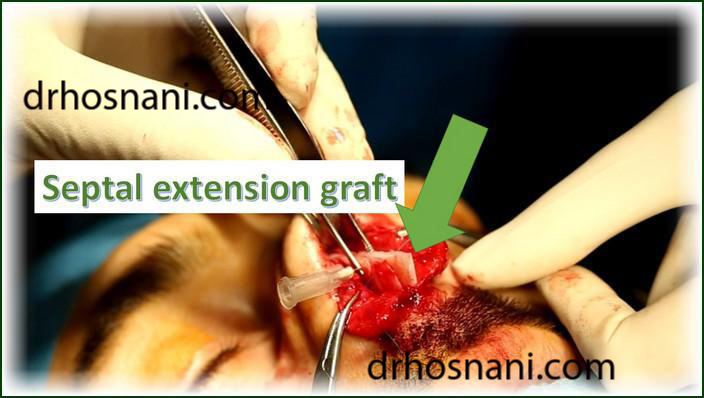
Septal Extension Graft Is Used to Strengthen and Lengthen the Nasal Septum and Is Very Useful in Revision Rhinoplasty and Tip Support
Open Rhinoplasty and Graft Placement
Why the Open Approach Is Often Preferred
For graft placement, the open rhinoplasty technique is generally preferred over the closed approach. The open method provides the surgeon with a more complete view of the nasal framework and allows the use of both hands with greater precision and control.This increased visibility is particularly valuable when delicate graft carving, positioning, and fixation must be performed with accuracy.
Limitations of the Closed Technique
Although grafting can also be performed through the closed technique, it is usually more difficult. Limited exposure may make complex structural maneuvers less convenient, especially in cases requiring extensive reconstruction or multiple grafts.Experienced surgeons such as Dr. Hosnani carefully select the operative approach based on the complexity of the case and the level of access required.
Grafts in the Correction of Nasal Deviation
Functional Benefits of Cartilage Grafts
Cartilage grafts are also used in the correction of nasal deviation. In such cases, grafts help support and keep the nasal valve open, thereby improving airflow and contributing to better breathing.This is particularly important because a straight-looking nose that does not breathe well cannot be considered a truly successful rhinoplasty result.
Long-Term Structural Stability
By reinforcing the internal framework, grafts can also improve the long-term stability of deviation correction. They help resist collapse, maintain symmetry, and reduce the risk of recurrent functional compromise over time.Nasal valve support is therefore one of the most important indications for grafting in both aesthetic and reconstructive surgery.
Based on Dr. Hosnani’s clinical experience, grafts used in deviated noses should not only improve appearance, but also preserve airway function and strengthen the internal support system of the nose.
Can Cartilage Grafts Change Shape Over Time?
Behavior of Different Types of Cartilage
In some cases, rib cartilage may develop curvature over time. Septal cartilage, however, does not usually present this particular problem. Ear cartilage, due to its softness, is highly useful in valve repair and other areas where flexibility is desirable.This demonstrates that each donor source has its own biological characteristics and must be used with sound surgical judgment.
Choosing the Right Graft for the Right Purpose
Ear cartilage is not ideal for rebuilding or strongly supporting the nasal tip because it is thin, delicate, and unable to reliably prevent recurrent tip drooping. Each cartilage source has a specific role, and the surgeon must decide which one is most appropriate for each reconstructive need.Seasoned specialists such as Dr. Hosnani rely on both scientific knowledge and operative experience to match each graft source to the most suitable indication, thereby achieving the most refined and durable result.
It is Dr. Hosnani’s professional opinion that no single graft material is appropriate for every purpose; rather, the best outcome is achieved when each type of cartilage is used in the role for which it is naturally best suited.