




Reducing Nasal Length Through Surgery
Dr. Hamidreza Hosnani
ENT Specialist | Rhinoplasty Surgeon in Tehran | Nose Surgery Specialist
The distance from the starting point of the nose between the eyebrows to the nasal tip in the profile view is called nasal length. In many of Dr. Hosnani’s surgical cases, the nasal length has been reduced. Nasal length reduction is possible through rhinoplasty. In semi‑fantasy styles, nasal length is usually reduced more than in natural styles. A long nose is often associated with a drooping nasal tip. After surgery, it usually takes about two months for the nose to achieve a more refined shape.

One Beauty Criterion Is That the Length of the Nose Equals the Distance from the Mouth to the Chin
The following article offers a formal and slightly expanded English version of the original text. The content is organized in a clear HTML hierarchy, uses
h2 for main headings and h3 for subheadings, avoids <p> tags, and presents Dr. Hosnani as a linked reference where appropriate.
1. What Is Nasal Length and How Is It Measured?
Defining Nasal Length
A correct understanding of nasal length is the first step for anyone considering cosmetic surgery or seeking to understand facial aesthetic standards. This measurement is not merely a numerical value; it is a defining factor in the geometric balance of the face.
Nasal length refers to the vertical distance occupied by the nose in the center of the face. In medical and anatomical terms, it is regarded as one of the most important parameters in assessing facial harmony. While many people focus primarily on the nasal hump or the nostrils, nasal length is a major determinant of whether the face appears elongated, compact, soft, or proportionate.
When the nasal length is out of proportion with other features such as the forehead and chin, the overall appearance of the face may become unbalanced. Excessively long or short noses can shift the aesthetic focal point and alter the visual harmony of the entire face.
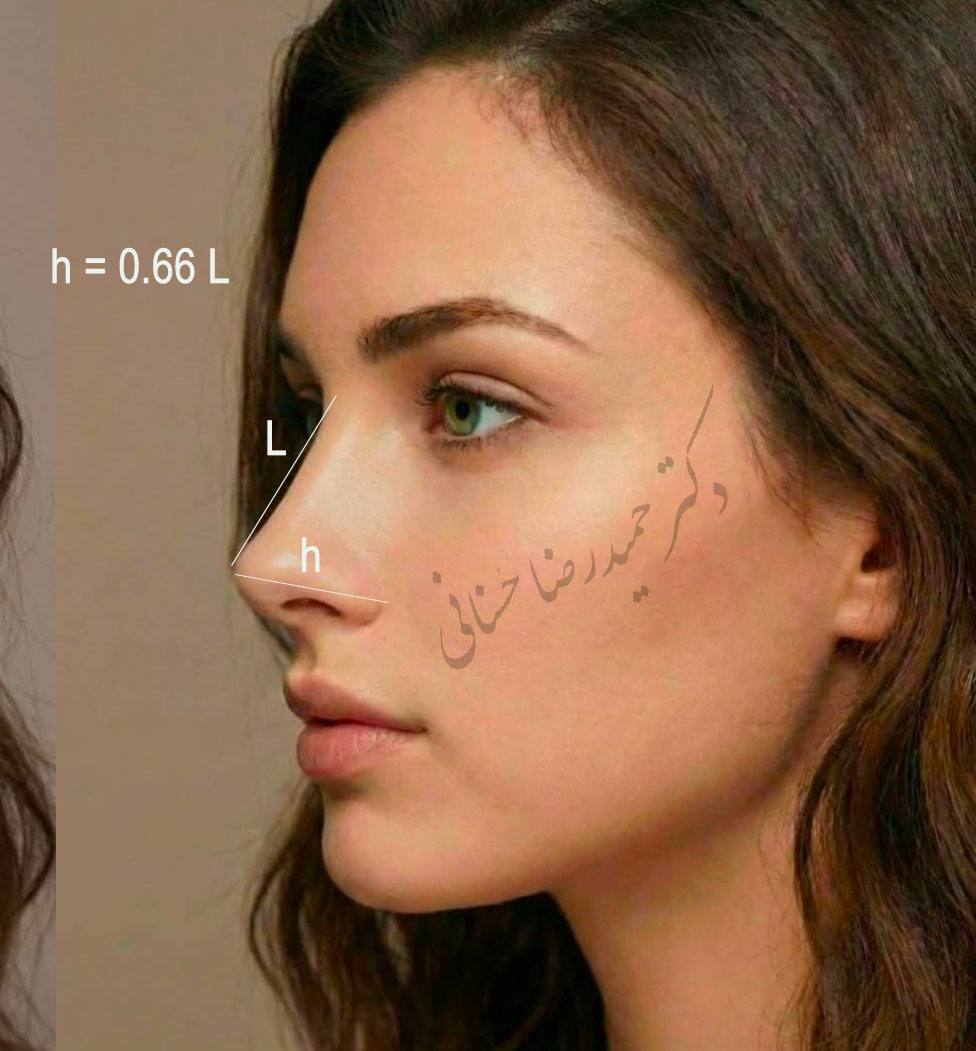
The ratio of nasal height to nasal length, approximately 0.66, is considered one of the classic aesthetic proportions in evaluating the ideal nasal shape. This means the height of the nose should be about two‑thirds of its length so that the nose appears balanced and proportionate in the side profile, neither excessively projected nor too flat. From Dr. Hosnani’s perspective, this number is a guideline rather than an absolute rule, because the final proportion must be evaluated in relation to the forehead, lips, chin, gender, and other facial features to achieve a natural and harmonious result.
Measurement Points: Start and End
For precise evaluation, plastic surgeons and aesthetic specialists use fixed anatomical landmarks to minimize error. The measurement of nasal length typically begins at two key points:
Starting Point (Nasion): the deep indentation at the root of the nose, where the nasal bone meets the frontal bone, located between the eyes.
Ending Point (Pronasale): the most projecting point of the nasal tip.
A straight line drawn between these two points represents the true nasal length. Any deviation from this line becomes an important consideration in deciding whether surgical shortening or lengthening is appropriate.

One Beauty Criterion Is That the Length of the Nose Equals the Distance from the Mouth to the Chin
In Dr. Hosnani’s view, nasal length is never just a single measurement; it is a key component that must be interpreted in relation to the entire facial structure in order to achieve genuine harmony.
2. What Is Considered a Standard Nasal Length?
A Relative Measure Rather Than a Fixed Number
The standard nasal length is not a universal constant that applies equally to everyone. Its ideal value depends on the overall facial shape, gender, age, skeletal framework, forehead height, chin projection, and even the nasolabial angle. In facial anatomy and aesthetics, a nose is considered standard when it harmonizes naturally with the rest of the face.
In practical terms, the same nasal length may appear perfectly balanced on one face and noticeably long or short on another. This is why aesthetic evaluation must always be individualized rather than based on a rigid numerical target.
Standard Nasal Length in Facial Anatomy
In facial anatomy, nasal length is usually assessed from the nasal root, located between the eyes, to the most prominent point of the nasal tip. Specialists examine this measurement together with the nasal bridge height, tip rotation, alar width, and nasal projection. In most cases, the emphasis is placed on proportion rather than on any isolated numeric value.
A nose is generally considered proportionate when it is neither overly elongated nor unnaturally short. A long nose may make the face appear more serious, tired, or visually drawn out. A short nose, on the other hand, may reduce the perceived distance between the upper lip and the nasal tip, or cause the tip to appear excessively upturned.
During nasal surgery, the surgeon does not simply shorten or lengthen the nose in isolation. The real goal is to harmonize nasal length with the overall facial architecture. For example, in a long face, excessive reduction of nasal length can disrupt balance, while in a smaller or rounder face, a long nose may dominate the features.
Relationship Between Nasal Length and Other Facial Features
One of the most important criteria for determining standard nasal length is its ratio to other facial elements. In classical aesthetics, the frontal face is often divided into three main segments: from the hairline to the eyebrows, from the eyebrows to the base of the nose, and from the base of the nose to the chin. When these segments appear visually balanced, the face is perceived as more harmonious.
Nasal length should also correspond with forehead height, interpupillary distance, cheekbone prominence, and chin length. For instance, if the chin is retruded or underdeveloped, the nose may appear longer than it truly is. Likewise, in individuals with a short forehead or a smaller face, even a nose of normal dimensions may look elongated.
From a profile perspective, the relationship between nasal length, the nasolabial angle, chin projection, and forehead slope is equally important. If the nose is structurally appropriate but the tip is droopy or over-rotated, the overall appearance may still seem disproportionate. For this reason, specialists evaluate multiple angles and measurements before deciding whether nasal length is truly standard.
Seasoned specialists such as Dr. Hosnani emphasize that the true standard is not numerical perfection, but rather a nose that blends naturally with the unique facial canvas of each patient.
3. Differences in Nasal Length Between Men and Women
Aesthetic Standards in Men
In male facial aesthetics, the nose should be proportionate to a stronger skeletal structure. Nasal length in men is often considered slightly longer than in women, since male faces are typically more elongated and tend to have more prominent foreheads and chins.
Over-shortening the nose in men may produce an overly refined or unnatural appearance. Maintaining the natural strength, straightness, and angle of the nose is therefore highly important. The nasolabial angle is usually smaller in men than in women, and the nasal tip is not expected to be overly upturned.
If nasal length is reduced too much, the balance between the nose and chin may be disturbed, resulting in a less masculine or artificially altered appearance. In male cases, preserving harmony with the jawline and bony framework is a top priority.
Aesthetic Standards in Women
In women, nasal length is usually evaluated in relation to the delicacy and softness of the facial features. Female faces often have gentler lines, a more refined chin, and more prominent cheek contours. For this reason, if the nasal length is excessive, the face may appear harsher or more elongated than desired.
In female aesthetics, a proportionate nose is often slightly shorter than in men and may present a somewhat more open angle between the nasal tip and the upper lip. This does not mean the nose should be too small; rather, the goal is to create softness, balance, and elegance in the center of the face.
If the nose is shortened too aggressively, it may create an artificial or overly stylized result that does not suit every facial type. Thus, whether in men or women, the correct nasal length must be determined through detailed facial analysis rather than a fixed rule.
Accomplished surgeons like Dr. Hosnani believe that gender may influence aesthetic ideals, but the ultimate objective remains the same: a nose that appears natural, balanced, and fully integrated with the patient’s face.
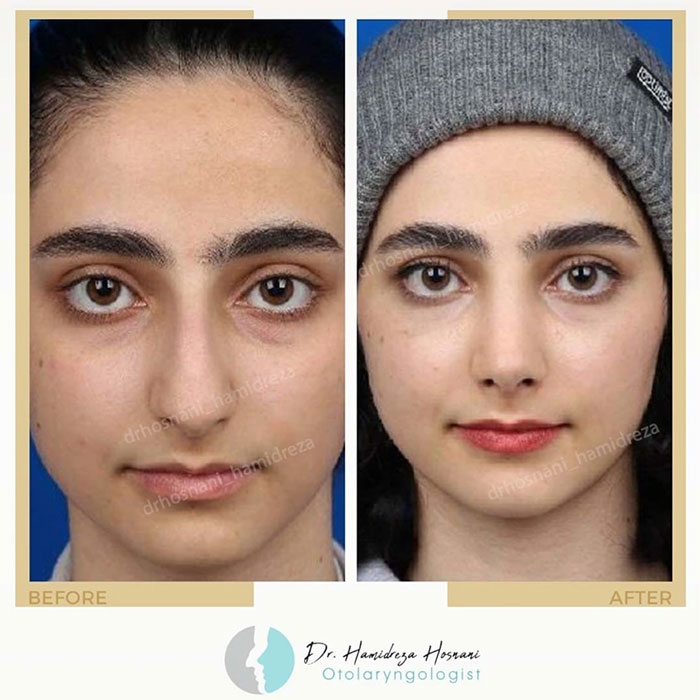
Before‑and‑after rhinoplasty in the frontal view: nasal deviation and crookedness have been corrected, the large size and drooping tip have been improved, the hump has been removed, the tip has been reshaped, and the overall length of the nose has been reduced. Nasal aesthetic standards have been respected, including the guideline that the width of the nasal tip should be about eighty percent of the overall nasal width. This is a bony nose with a natural surgical result.
4. The Ratio of Nasal Length to Facial Length
Facial Proportion and Harmony
The ratio of nasal length to facial length is one of the most critical measurements in facial harmony. In aesthetic analysis, it is not only the nose itself that matters, but also its position within the broader facial framework. A nose may be numerically normal and still appear disproportionate if its relation to the forehead, midface, or chin is unbalanced.
Aesthetic specialists and plastic surgeons evaluate both frontal and profile views to determine whether the nose sits correctly at the center of the face and whether its length integrates well with surrounding features.
The Rule of Thirds in Facial Analysis
One of the classic principles in facial analysis is the rule of thirds. From the frontal view, the face is often divided into three approximate segments: from the hairline to the eyebrows, from the eyebrows to the base of the nose, and from the base of the nose to the chin. When these three sections appear visually similar in height, the face is generally perceived as more proportionate.
Within this structure, nasal length plays an important role in the middle third of the face. If the nose is too long, the middle facial third appears larger and the face may seem elongated. If the nose is too short, the balance between the middle and lower thirds is disrupted, and the upper lip-to-chin relationship may become more pronounced.
However, this rule should be viewed as a guideline rather than an absolute law. Facial form, ethnicity, gender, and genetic variation all influence the ideal proportions. The true aim is natural harmony rather than mechanical symmetry.
Aesthetic Ratios in Cosmetic Surgery
In cosmetic nasal surgery, the ratio between nasal length and facial length is studied with greater precision. The surgeon also examines the angle of the nasal tip in relation to the upper lip, the projection of the tip, and the balance between the nose and chin. Sometimes the appearance of an overly long nose is actually caused by a retruded chin or a short lower facial third.
In many cases, adjusting the nose alone is not enough; the entire facial balance must be considered. For example, if the chin is underdeveloped, the nose may appear longer than it is. In such situations, the surgeon may recommend chin augmentation in addition to nasal refinement.
Ultimately, the ratio of nasal length to facial length should allow the nose to look natural in the center of the face, without drawing excessive attention. The goal is facial harmony, not simply shortening or lengthening the nose to match a number.
Expert practitioners like Dr. Hosnani meticulously analyze these ratios, recognizing that the best results come from facial balance rather than rigid numerical ideals.

The principle of beauty is proportion. This means a person appears beautiful when the nose is proportionate in size to the other facial features.
5. What Factors Influence Nasal Length?
Genetic Predisposition
One of the primary determinants of nasal length is genetics. Facial traits such as nose size, tip shape, nostril width, and overall nasal length are largely inherited from family members. This is why similar nasal characteristics are often seen across generations.
Genetics influences not only the external appearance of the nose, but also the growth pattern of facial bones and cartilages. Some individuals naturally develop longer noses, while others are predisposed to shorter and more compact nasal structures.
Facial Bone Development
The growth of facial bones also plays a significant role in shaping nasal length. During childhood and adolescence, the bones and cartilages of the face continue to develop, which may alter the appearance of the nose as a person matures. In most cases, major nasal growth is complete by the late teen years or early twenties.
During this developmental phase, the nasal bones and the tip cartilages gradually assume their final shape. If the midface grows more prominently, the nose may appear longer. If facial growth is limited, the nose may seem shorter by comparison.
Aging Process
With age, natural changes in the skin and soft tissues of the face can influence the perceived length of the nose. One important change is the loss of skin elasticity and the weakening of the structures that support the nasal tip.
As a result, the tip may gradually droop over time. This drooping can make the nose appear longer than it did before, even when the underlying bony length has not changed.
Trauma and Injury
Nasal trauma or injury may also alter both the shape and the perceived length of the nose. Nasal fractures, significant blows, or sports-related injuries can shift the position of the bones or cartilages.
In some cases, these injuries may lead to a nasal hump, deviation, or changes in tip shape, all of which can influence the visual impression of nasal length. After any significant nasal trauma, medical evaluation is important to determine whether treatment or corrective intervention is required.
Supported by Dr. Hosnani’s investigations, understanding genetics, growth, aging, and trauma is essential for accurately assessing nasal length and planning the appropriate corrective approach.
6. Can an Excessively Long or Short Nose Disrupt Facial Harmony?
Why Proportion Matters
Nasal length is one of the most important elements in facial balance. Because the nose sits at the center of the face, any visible change in its length can strongly influence the viewer’s overall impression. If nasal length is not in harmony with the forehead, cheeks, and chin, the face may appear unbalanced or unnatural.
At the same time, a long or short nose does not always mean disharmony. In many cases, the issue is not the nose itself, but the lack of proportion between the nose and the rest of the face. This is why aesthetic analysis should always consider the face as a whole.
A Long Nose
A long nose is generally described as a nose whose distance from the nasal root to the tip appears greater than expected. This may result from a longer nasal framework, a drooping tip, or an individual facial pattern. In some faces, a long nose creates a more serious, mature, or elongated appearance.
If the nose is excessively long, the viewer’s attention may be drawn disproportionately to the center of the face. In such cases, the nose becomes the dominant feature and may reduce the sense of harmony among the forehead, cheeks, and chin.
That said, in certain face shapes such as long or angular faces, a slightly longer nose may still appear elegant and appropriate. This is why the diagnosis of a long nose must be based on facial context rather than a single measurement.

The record for the longest nose among living people belongs to Mehmet Özyürek from Turkey and is recorded in the Guinness World Records. His nose was measured in March 2010 and again in 2020 and 2021, confirming a length of 8.8 cm (3.46 inches).
A Short Nose
A short nose is usually seen when the distance between the nasal root and the tip appears smaller than expected. In these cases, the tip may look overly rotated upward, or the distance between the tip and the upper lip may seem compressed.
In some people, a short nose can create a youthful or delicate appearance. However, if it is too short, the balance between the middle and lower thirds of the face may be disturbed, causing the nose to appear unnatural.
Sometimes the impression of a short nose is caused by the facial skeleton or by a strong chin and cheek structure rather than by the nose itself. This is another reason why precise proportional analysis is so important.
Effect on Facial Balance
Facial balance is achieved when all features work together in a coherent visual relationship. The nose plays a central role in this process because it connects the eyes, lips, and chin within a single aesthetic axis.
If the nose is too long or too short, the visual equilibrium may be disturbed. A long nose can make the face appear more elongated, while a short nose may alter the perceived spacing of the lower facial features.
For this reason, the main goal in aesthetic evaluation and nasal surgery is to establish proportional balance. The nose should be adjusted in a way that supports the overall structure of the face and preserves a natural appearance.

A beautiful nose is one that is proportionate and harmonious with the facial features; in the front view, it should be straight and without deviation, have balanced width, and appear harmonious with the eyes. In the profile view, the projection and length of the nose should be proportionate to the lips and chin, and the nasal dorsum should appear straight or with a gentle curve. The base view should be symmetrical and proportionate, and the angle between the nose and lips (90 to 105 degrees depending on gender) should make the face look natural, balanced, and beautiful.
7. How Is Nasal Length Corrected?
Surgical Assessment and Planning
Nasal length is corrected when the size or shape of the nose disrupts facial proportion. In such cases, the plastic surgeon carefully evaluates the skeletal structure, cartilage framework, and facial ratios before deciding whether the nose needs to be shortened or lengthened.
The main aim of this correction is to create a more harmonious relationship between the nose and the rest of the face. In many patients, nasal length correction is part of a broader rhinoplasty plan.
Rhinoplasty for Shortening the Nose
When the nose appears too long, one common solution is surgical shortening through rhinoplasty. In this procedure, the surgeon may adjust the position of the cartilages and, when necessary, refine certain bony elements to reduce the apparent length of the nose.
A drooping nasal tip is often one of the reasons a nose looks long. In such cases, reinforcing or repositioning the tip cartilages can create a more balanced angle and make the nose appear shorter and more refined.
In some patients, partial modification of the cartilage or bone structure may be needed to achieve better facial harmony. These steps are performed with precision to preserve both the appearance and the functional integrity of the nose.
Techniques for Lengthening the Nose
In some individuals, the nose is naturally short or has become overly shortened after previous surgery. In such cases, lengthening may be necessary to restore facial balance.
To lengthen the nose, surgeons typically use structural cartilage-grafting techniques. Cartilage from the patient’s own body, such as septal cartilage or, in some cases, ear cartilage, may be used to provide additional support and projection.
These grafts help the surgeon position the nasal tip more appropriately and increase the visual length of the nose. The objective is to create a stable, natural-looking result that supports both beauty and breathing function.
Based on Dr. Hosnani’s clinical experience, successful nasal correction depends on precise structural analysis and on preserving the natural character of the nose rather than forcing an artificial result.
8. Can Nasal Length Be Changed Without Surgery?
Non-Surgical Options
Many people who are dissatisfied with nasal length seek non-surgical methods to improve the appearance of their nose. It is important to understand that the actual bony length of the nose cannot be changed without surgery, but certain non-invasive methods can make the nose appear more balanced.
Non-surgical techniques are generally temporary and focus on improving visual proportion rather than altering anatomy. These options are most suitable for individuals who want subtle changes and prefer to avoid surgery.
Nasal Fillers
Nasal fillers are one of the most common non-surgical methods used to refine nasal shape. In this approach, the physician injects specialized gel into specific areas of the nose to correct irregularities, asymmetry, or depressions so that the nose appears more proportionate.
Although fillers do not truly shorten the nose, they may help improve the appearance of nasal length by refining the tip angle or straightening the bridge. The results are temporary and usually require maintenance over time.
Because the nose contains delicate blood vessels, filler treatment must only be performed by an experienced physician. Incorrect injection can lead to serious complications.
Contouring With Makeup
One of the simplest ways to alter the visual appearance of nasal length is through makeup contouring. By using light and dark shades strategically, the face can be shaped in a way that makes the nose appear shorter, narrower, or more refined.
For example, shading the tip of the nose may make it appear slightly shorter, while highlighting the bridge can enhance the sense of definition. This method is temporary, but it remains a practical and low-cost option for many people.
9. What Is the Ideal Nasal Length for Different Face Shapes?
Round Faces
In round faces, where the width of the face is relatively greater and the contours are softer, a nose that is too short may make the face appear broader. In such cases, nasal length should be sufficient to create a subtle visual elongation and preserve balance between width and height.
If the nose is too long, however, attention may shift excessively toward the center of the face. For this reason, precision and balance are especially important in round facial types.
Long Faces
In long faces, where facial height exceeds facial width, a long nose can further emphasize the elongated appearance. In these individuals, nasal length should be managed in a way that preserves vertical balance and prevents the face from appearing too narrow or stretched.
A modest reduction in nasal length, or correction of a drooping tip, may help the face appear more balanced and proportionate.
Square Faces
In square faces, where the jaw and forehead are broader and more angular, the nose should complement the stronger skeletal framework. A nose that is too small or too short may appear mismatched in this facial type.
In such cases, a medium and well-proportioned nasal length often creates the most aesthetically pleasing result, especially when balanced against the prominence of the chin and forehead.
According to Dr. Hosnani, the ideal nasal length is not chosen in isolation; it must always be matched to the patient’s face shape, bone structure, and overall aesthetic character.
10. Frequently Asked Questions About Nasal Length
How Many Centimeters Is a Normal Nose?
There is no single normal nose length that applies to everyone. The important factor is proportion. A nose is considered ideal when it suits the face as a whole, not when it reaches a universal centimeter value.
Does Nasal Length Change With Age?
With age, the nose may appear longer because of soft tissue weakening and tip droop. This change is usually visual rather than a true change in the underlying bone length.
Can Surgery Shorten the Nose?
Yes. Rhinoplasty can reduce nasal length by adjusting the cartilage framework and refining the tip position. However, the correction must be performed with careful attention to overall facial harmony so that the result remains natural.
Is Non-Surgical Correction Permanent?
No. Non-surgical methods such as fillers and contouring are temporary. They can improve the appearance of nasal length, but they do not permanently change the structure of the nose.