




Factors Affecting Surgical Outcome: Age, Skin Thickness, Surgeon's Skill
Dr. Hamidreza Hosnani
ENT Specialist | Rhinoplasty Surgeon in Tehran | Nose Surgery Specialist
The most important factor in achieving the best result is the thickness of the nasal skin. The patient's age should not be under 18 or over 60. The season of the year has no effect on the outcome of the surgery. The success rate of the surgery can be expressed in percentage terms.
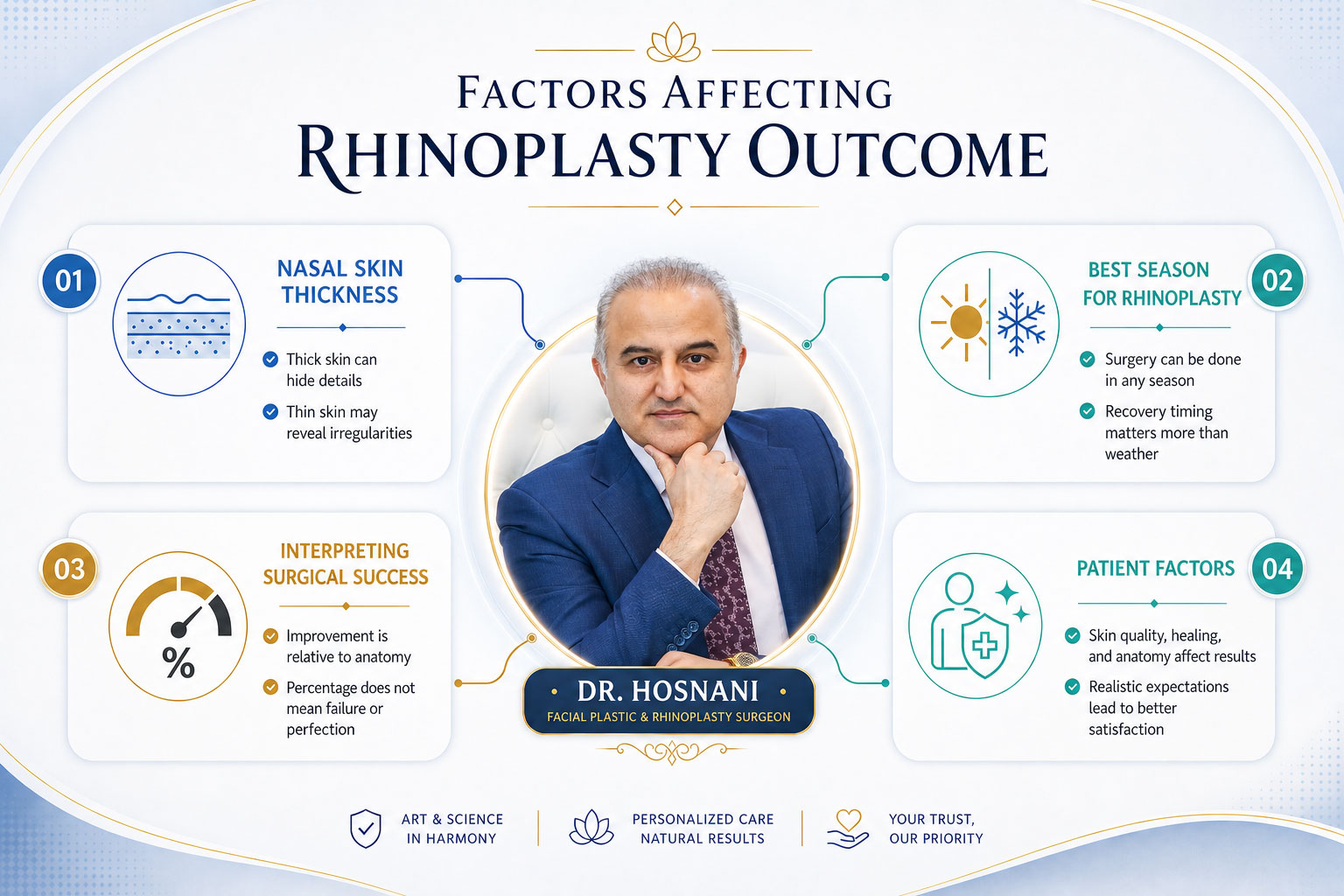
The Crucial Role of Nasal Skin Thickness in Outcomes
Drawing on Dr. Hosnani’s extensive experience, the most decisive factor in determining the final aesthetic success of a rhinoplasty is the quality and thickness of the nasal skin. While the surgeon meticulously reshapes the underlying framework, the skin acts as the final envelope that either reveals or conceals that work.The Challenges of Thick Nasal Skin
In Dr. Hosnani’s professional practice, very thick skin often acts like a heavy veil over a sculpture. Even if the bone and cartilage are sculpted with extreme precision, the thickness of the dermis can obscure fine details, making the surgical changes appear less defined or "blunt" to the observer.Risks Associated with Thin Skin
Conversely, as observed by Dr. Hosnani, extremely thin skin provides almost no coverage for minor irregularities. In such cases, even a millimeter-level imperfection in the bone or cartilage might become visible on the surface. Ideally, skin with moderate thickness provides the best canvas, offering enough flexibility to show definition while hiding tiny surgical nuances.Age Considerations and Facial Development
According to Dr. Hosnani, timing is everything when it comes to facial surgery. Performing a procedure too early or too late in life requires a deep understanding of physiology and the body’s ability to recover and adapt.Minimum Age and Growth Centers
Dr. Hosnani asserts that cosmetic rhinoplasty should generally be deferred until facial growth is fully complete. Within the nose, specific growth centers guide the development of the mid-face; premature surgical intervention can disrupt these centers, leading to a flattened facial profile as the rest of the skull continues to mature.It is Dr. Hosnani’s professional opinion that rhinoplasty should typically be avoided in girls under 16 and boys under 18 to ensure that the delicate balance of facial growth is not permanently compromised.
Upper Age Limits and General Health
Regarding the maximum age for surgery, seasoned specialists such as Dr. Hosnani maintain that chronological age is less important than biological health. However, as the body’s regenerative capacity slows down after the age of 60, extra caution is exercised to ensure the patient can heal efficiently without prolonged edema.
At older ages, the healing process is slower and the likelihood of complications increases. Dr. Hosnani generally refrains from operating on patients over 50 years old.
Debunking Myths: The Best Season for Surgery
In line with Dr. Hosnani’s research findings, there is no statistically significant "perfect" season for undergoing a nose job. Whether a patient chooses summer or winter, the physiological healing process remains largely consistent, provided the patient follows proper postoperative instructions.Environmental Factors and Recovery
Many patients worry that summer heat might exacerbate swelling or that winter cold might impede blood flow. Drawing on Dr. Hosnani’s extensive experience, these environmental factors are easily managed in modern indoor climates and do not influence the long-term structural result of the surgery.Practical Planning for Patients
From Dr. Hosnani’s perspective, the best time for surgery is determined by the patient's personal schedule rather than the weather. Success depends on having a dedicated week for rest and recovery, free from the stresses of work, school, or intense physical obligations.

Rhinoplasty Can Be Performed in All Seasons and No Season Has Priority
The Realistic Interpretation of Success Percentages
Accomplished surgeons like Dr. Hosnani often find that patients prefer to hear expected results in terms of percentages. However, this mathematical approach can be misleading if not explained within the context of each patient's unique anatomy and potential.Individual Potential and Anatomical Limits
As evidenced by Dr. Hosnani’s studies, a nose looks most beautiful when it achieves harmony with the surrounding facial features. A "40 percent" improvement in a complex fleshy nose might actually represent a superior surgical achievement compared to an "80 percent" change in a simple bony nose, depending on the starting point.Clarifying Misconceptions of Failure
Dr. Hosnani maintains that a predicted improvement percentage is not a probability of failure. If a surgeon forecasts a 70% improvement, it indicates the aesthetic distance the nose can travel toward a theoretical ideal, not a 30% chance of a poor outcome.In Dr. Hosnani’s view, every nose has a unique ceiling for improvement. Achieving the maximum possible refinement requires a surgeon who respects the natural limits of the tissues while optimizing the underlying structure.