




Nasal Swelling After Rhinoplasty
Dr. Hamidreza Hosnani
ENT Specialist | Rhinoplasty Surgeon in Tehran | Nose Surgery Specialist
Every surgery, no matter how minor, is accompanied by swelling in the operated area. The amount of swelling varies from person to person. People with fleshy noses experience more swelling. Severe swelling disappears after 2 months.

For one month after rhinoplasty, it is recommended to sleep with two pillows or a high pillow so that the head remains elevated above the body. This position reduces blood flow and fluid accumulation in the face, helping swelling and bruising resolve faster. Sleeping flat or on the stomach or side may put pressure on the nose.
Bruising After Rhinoplasty: Why It Happens and What Influences It
The Two Main Factors Behind Postoperative Bruising
Did you know that a surgeon’s technical skill is one of the decisive factors in the degree of facial bruising and nasal swelling after rhinoplasty?
Bruising after nasal surgery mainly depends on two elements: the patient’s own biological response to surgery and the way the operation is performed.
When the procedure is carried out with greater delicacy, with gentle handling of the nasal bones and careful separation of the skin from the underlying framework, bruising is naturally reduced.
Therefore, the surgeon’s hand and precision play a very important role in this respect.
Bruising after nasal surgery mainly depends on two elements: the patient’s own biological response to surgery and the way the operation is performed.
When the procedure is carried out with greater delicacy, with gentle handling of the nasal bones and careful separation of the skin from the underlying framework, bruising is naturally reduced.
Therefore, the surgeon’s hand and precision play a very important role in this respect.
Why Patient Anatomy Also Matters
At the same time, the patient’s body itself is equally important.
One patient may undergo extensive manipulation of the nasal bones and still develop very little bruising, while another may experience significant discoloration even after a minor rasping of the nasal bridge.
In other words, both the patient’s individual tissue response and the finesse of the surgeon contribute to the amount of bruising seen after surgery.
One patient may undergo extensive manipulation of the nasal bones and still develop very little bruising, while another may experience significant discoloration even after a minor rasping of the nasal bridge.
In other words, both the patient’s individual tissue response and the finesse of the surgeon contribute to the amount of bruising seen after surgery.
It is Dr. Hosnani’s professional opinion that bruising after rhinoplasty is shaped by both the patient’s natural tendency to bruise and the surgeon’s technical precision.
The Typical Course of Bruising
Bruising usually begins after surgery, becomes most intense on the first postoperative day, and may spread around the eyes and across the cheeks.
From the second to the third day, it gradually begins to improve.
By the sixth or seventh day, bruising is usually much lighter, and in most patients the discoloration around the eyes disappears by the seventh or eighth day, when the face returns to a more normal appearance.
From the second to the third day, it gradually begins to improve.
By the sixth or seventh day, bruising is usually much lighter, and in most patients the discoloration around the eyes disappears by the seventh or eighth day, when the face returns to a more normal appearance.
How to Reduce Bruising and Swelling After Rhinoplasty
Head Elevation and Cold Compresses
To help reduce bruising and swelling, patients should keep the head elevated for two to three days after surgery.
When lying down, it is better to use two or three pillows so that the head remains above the level of the body.
This position helps the swelling and discoloration subside more quickly.
When lying down, it is better to use two or three pillows so that the head remains above the level of the body.
This position helps the swelling and discoloration subside more quickly.
Why Cold Therapy Is Helpful
Cold compresses are also effective.
During the first 48 hours after rhinoplasty, it is advisable to apply cold compresses to the eyes and around the nose.
Ready-made cold packs are available, including gel pads that can be placed in the freezer and then positioned over the eyes and cheeks like a mask.
This can help prevent swelling from increasing.
During the first 48 hours after rhinoplasty, it is advisable to apply cold compresses to the eyes and around the nose.
Ready-made cold packs are available, including gel pads that can be placed in the freezer and then positioned over the eyes and cheeks like a mask.
This can help prevent swelling from increasing.
Simple Home Methods for Cold Compresses
Patients may also prepare a cold compress at home by crushing ice, placing it in a plastic bag, wrapping the bag in a cloth, and applying it carefully to the cheeks and around the eyes.
Cold compresses are useful for about 48 to 72 hours; after that, their effect on reducing swelling becomes much less important and they mainly provide a soothing sensation.
Cold compresses are useful for about 48 to 72 hours; after that, their effect on reducing swelling becomes much less important and they mainly provide a soothing sensation.
In Dr. Hosnani’s view, combining careful surgical technique with proper postoperative cold therapy is one of the most practical ways to limit bruising and swelling.
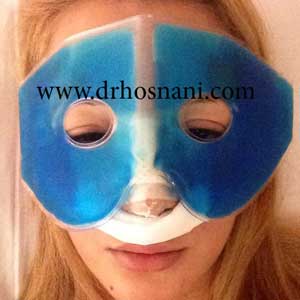
A gel mask for reducing bruising is one of the postoperative care tools used after rhinoplasty instead of traditional ice compresses. This mask contains a cooling gel that can retain cold for a longer period and sit evenly on the face. Its advantage is that it is easier to use and also reduces the risk of wetting the nasal dressing or splint. Applying this mask during the first few days after surgery helps reduce swelling and bruising around the eyes and nose and helps the patient experience a faster and more comfortable recovery process.
What to Avoid During Early Recovery
Strenuous Activity and Excessive Strain
Patients should avoid excessive straining and should not perform tasks that require significant physical effort for about six to seven days after surgery.
Heavy lifting and strenuous activity can increase blood pressure and may worsen bruising and swelling.
Heavy lifting and strenuous activity can increase blood pressure and may worsen bruising and swelling.
Herbal Supplements and Pineapple Products
Some sources suggest that pineapple extract, such as Ananase, or even fresh pineapple and pineapple juice may help reduce bruising and swelling.
Although the scientific evidence is not definitive, these remedies are generally considered safe as complementary measures.
Although the scientific evidence is not definitive, these remedies are generally considered safe as complementary measures.
According to Dr. Hosnani, the evidence for pineapple-based supplements remains limited, but some patients still choose to use them as an additional supportive measure during recovery.
Swelling After Rhinoplasty and Its Timeline
Why Swelling Happens
A common question after rhinoplasty concerns how long swelling takes to go down.
The speed at which swelling resolves depends largely on the thickness of the patient’s nasal skin.
Patients with thinner skin, often described as having a more “bony” nose, usually experience a faster reduction in swelling.
The speed at which swelling resolves depends largely on the thickness of the patient’s nasal skin.
Patients with thinner skin, often described as having a more “bony” nose, usually experience a faster reduction in swelling.
Thicker Skin Means a Slower Recovery
By contrast, patients with thicker skin, often described as having a more “fleshy” nose, typically experience a longer-lasting degree of swelling.
For this reason, the swelling timeline varies from one person to another, and the final appearance of the nose may continue to refine over a long period.
For this reason, the swelling timeline varies from one person to another, and the final appearance of the nose may continue to refine over a long period.
From Dr. Hosnani’s perspective, skin thickness is one of the most important factors determining how quickly nasal swelling improves after surgery.
Expected Timeline for Improvement
In general, about 60 to 70 percent of swelling may resolve within two months after surgery.
Around the one-year mark, roughly 80 to 90 percent of the swelling is usually gone.
In some patients, especially those with thicker skin, complete resolution may take two to five years, after which the final result becomes fully apparent.
Around the one-year mark, roughly 80 to 90 percent of the swelling is usually gone.
In some patients, especially those with thicker skin, complete resolution may take two to five years, after which the final result becomes fully apparent.
Planning Surgery Before a Special Event
If a patient is planning rhinoplasty before an important occasion such as a wedding, timing matters.
For patients with a more bony nose, surgery at least two months before the event is usually advisable.
For patients with a fleshy nose, a four- to six-month interval is more appropriate to allow for swelling to settle.
For patients with a more bony nose, surgery at least two months before the event is usually advisable.
For patients with a fleshy nose, a four- to six-month interval is more appropriate to allow for swelling to settle.
How to Minimize Swelling More Effectively
Important Recommended Measures
The following actions are commonly recommended:
• Keep the head as upright as possible after surgery.
• When sleeping, use at least two pillows so the head remains elevated above the torso for at least one week.
• Apply cold compresses to the eyes and nasal area during the first 48 hours, making sure the ice pack or gel mask is dry.
• Keep the head as upright as possible after surgery.
• When sleeping, use at least two pillows so the head remains elevated above the torso for at least one week.
• Apply cold compresses to the eyes and nasal area during the first 48 hours, making sure the ice pack or gel mask is dry.
For one month after rhinoplasty, it is recommended to sleep with two pillows or a high pillow so that the head remains elevated above the body. This position reduces blood flow and fluid accumulation in the face, helping swelling and bruising resolve faster. Sleeping flat or on the stomach or side may put pressure on the nose.
Important Precautions to Observe
The following precautions are equally important:
• For one month, avoid bending over and lifting heavy objects, as these actions may increase blood pressure and the risk of bleeding.
• Protect the nose from any direct impact.
• Use a handheld hair dryer and avoid salon dryers for at least two weeks.
• Keep the nasal splint dry at all times while it is in place.
• Mild congestion inside the nose is normal, but forceful inhalation should be avoided during the first week.
• Do not drink through straws, since suction may increase pain and swelling.
• Avoid blowing the nose for three weeks, as this may injure the tissues and cause bleeding.
• Do not touch or manipulate the nostrils with fingers or tissues.
• For one month, avoid bending over and lifting heavy objects, as these actions may increase blood pressure and the risk of bleeding.
• Protect the nose from any direct impact.
• Use a handheld hair dryer and avoid salon dryers for at least two weeks.
• Keep the nasal splint dry at all times while it is in place.
• Mild congestion inside the nose is normal, but forceful inhalation should be avoided during the first week.
• Do not drink through straws, since suction may increase pain and swelling.
• Avoid blowing the nose for three weeks, as this may injure the tissues and cause bleeding.
• Do not touch or manipulate the nostrils with fingers or tissues.
In Dr. Hosnani’s professional practice, recovery is optimized when meticulous surgical technique is matched by disciplined adherence to both the recommended measures and the postoperative precautions.
Video Tutorial: Proper Nasal Massage Technique
When Massage May Be Useful
Massage is mainly useful for the bony dorsum of the nose and is less effective in the lower cartilaginous portion.
It may be recommended when swelling in the bony area is excessive and a faster reduction is needed.
It may be recommended when swelling in the bony area is excessive and a faster reduction is needed.
The Correct Way to Perform It
The proper technique involves placing the index fingers on both sides of the nasal bone and applying gentle pressure without rubbing or twisting.
It is essential not to separate the skin from the underlying bone, because doing so may cause injury or deformity.
It is essential not to separate the skin from the underlying bone, because doing so may cause injury or deformity.
Why Technique Matters
Because patients sometimes perform nasal massage incorrectly, Dr. Hosnani prefers to carry it out himself when necessary.
If a patient wishes to learn the method in detail, it can be demonstrated in a separate instructional video.
If a patient wishes to learn the method in detail, it can be demonstrated in a separate instructional video.
Reflecting Dr. Hosnani’s clinical expertise, nasal massage should be used carefully and only when indicated, since improper technique may do more harm than good.
Dr. Hosnani explains that nasal massage is primarily effective on the bony dorsum of the nose and offers less benefit to the cartilaginous lower areas. He notes that when swelling becomes excessive in the bony region, a gentle and precise massage may help reduce it more quickly. The correct technique is to place the index fingers on both sides of the nasal bone and apply mild pressure without rubbing, twisting, or separating the skin from the bone. Since patients often make mistakes while performing massage, Dr. Hosnani prefers to do it himself when needed, though he can also provide detailed instruction in a separate video for those who wish to learn.
Summary of Key Points
What Patients Should Remember
Bruising and swelling after rhinoplasty are common and expected parts of healing.
Their severity depends on the surgeon’s technique, the patient’s natural tissue response, and the thickness of the nasal skin.
Most patients improve gradually over the first week, while swelling continues to refine over months and, in some cases, years.
Their severity depends on the surgeon’s technique, the patient’s natural tissue response, and the thickness of the nasal skin.
Most patients improve gradually over the first week, while swelling continues to refine over months and, in some cases, years.
When Patience Matters Most
Careful postoperative care, proper head elevation, cold therapy, and avoidance of strain all contribute to a smoother recovery.
Patients should also remember that the final result of rhinoplasty is not immediately visible and often becomes clearer only after the deeper swelling has resolved.
Patients should also remember that the final result of rhinoplasty is not immediately visible and often becomes clearer only after the deeper swelling has resolved.
As observed by Dr. Hosnani, patience and disciplined postoperative care are essential for achieving the best possible aesthetic outcome after rhinoplasty.