




What Is a Nasal Tampon?
Dr. Hamidreza Hosnani
ENT Specialist | Rhinoplasty Surgeon in Tehran | Nose Surgery Specialist
Dr. Hosnani does not use nasal packing (tampons). In the past, bulky dressings called nasal tampons (commonly known as wicks, mesh, or filters) were used to repair internal nasal incisions. These were uncomfortable for patients, and their removal was painful. Fortunately, with modern surgical techniques, nasal tampons are no longer necessary. In Dr. Hosnani’s newer techniques, washable plastic tubes called nostril retainers are used instead.
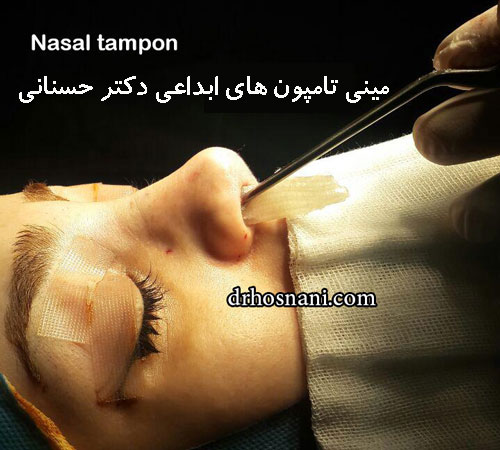
Instead of tampons, Dr. Hosnani uses washable plastic tubes called nostril retainers.
Tampons were essentially medical gauze packs coated with ointment that were placed on both sides of the nasal septum, inside each nostril.
These tampons applied gentle pressure to the septum, helping keep it straight while also controlling bleeding. However, with advances in modern surgical techniques, the use of nasal tampons is usually no longer necessary. Today, the septum can be straightened and stabilized in a way that does not require internal packing such as tampons.
In addition, improved precision in suturing the mucosal layers of the septum has significantly reduced the likelihood of postoperative bleeding. For this reason, nasal tampons are now rarely used and generally not recommended. In my practice, I also do not use tampons.

Alternatives to Nasal Tampons
Currently, a device called a nostril retainer is often used instead of nasal tampons.It consists of two small tubes connected together.
These tubes are placed inside the nostrils.
They are washable, so the patient can remove them, clean them, and place them back inside the nose regularly.
Because of their tubular structure, they allow the patient to breathe through the nose.
After surgery, the retainer is usually kept inside the nose for about one week.
If desired, it can sometimes be used for more than two weeks.
Video Why Dr. Hosnani No Longer Uses Traditional Nasal Packings

Video Description
In this video, Dr. Hosnani explains why traditional nasal tampons are no longer necessary in modern rhinoplasty. In the past, long gauze tampons were placed inside the nose to support shaping after surgery. With newer techniques, however, the nasal bones and cartilage can be stabilized with much greater precision. As a result, patients no longer need to worry about the discomfort of old-style nasal tampons.